
Established by the UN in 2015, each year on 11 February, the International Day of Women and Girls in Science (IDWGS) aims to promote and celebrate women and girl’s full and equal access and participation in STEM (Science, Technology, Engineering, and Mathematics) sectors.
In this blog, we shine the spotlight on a range of our talented CFP researchers who share their reflections on working in forest science…
Meet the researchers who are sharing their stories:
Berglind Karlsdóttir is a Social Scientist at Forest Research and is part of our Farmer action for tree resilience project team.
Dr Alexandra Ash is a Postdoctoral Research Fellow at the University of Southampton and Mammal Ecologist at Forest Research. Her PhD formed our Understanding grey squirrel damage in UK woodlands Phase 1 project, and she is now working on the follow up Phase 2 project: Understanding grey squirrel bark stripping.
Dr Claire Bratley is a Research Technician in the Silviculture and Wood Properties Team at Forest Research. She is also involved with two CFP projects: The wind within the trees: understanding wind storm risks in continuous cover forestry and Detecting and understanding oak shake.
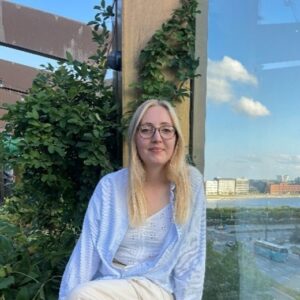
Phoebe Swift is a CFP-funded PhD student and former CFP intern at Kew Gardens. She also works as part of the Investigating ash health genomics after long-term ash dieback exposure CFP project team.
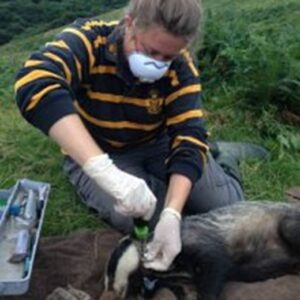
Dr Cally Ham is a Senior Scientist in Mammal Ecology at Forest Research. She is also co-lead on our Understanding grey squirrel bark stripping project.
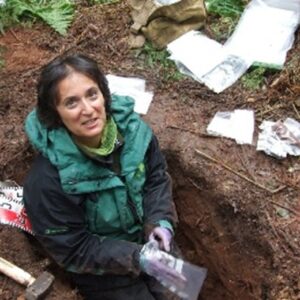
Dr Elena Vanguelova is a Senior Biogeochemist and Soil Sustainability Research Leader at Forest Research. She is also part of the EXPLORATION: Mixed species planting for drought adaptation CFP project team.
Did you always know that you wanted to work in forest science?
Berglind grew up in a small town in Denmark, but always had a passion for all things nature, wildlife and travel: “When I was 19, I decided I wanted to study wildlife conservation. They don’t really teach that in Denmark, so I moved to Bristol to study at the University of the West of England. I spent a couple of amazing years after that travelling and volunteering. In particular, I got an unpaid position with Frontier and lived in a tent in Costa Rica for six month. I then did a Master’s in Conservation Science at Imperial College London. During my course I realised that people are the key to solving the challenges of our natural world. After this, I knew I wanted to do something social science related.”
Alex knew from a young age that she wanted to work with wildlife “I was completely captivated by Sir David Attenborough’s documentaries and would watch Planet Earth and Blue Planet on repeat.” She was also fortunate enough to have lived in a range of countries whilst growing up including Scotland, Malaysia, Australia and America: “Experiencing such varied environments gave me a deep appreciation for the natural world and the importance of conserving it.”
Claire has always been a scientist at heart but started off her career in a different scientific discipline: “I am interested in how the way we grow trees affects their timber properties. My previous experience in neuroscience might seem unusual, but my new career at Forest Research allows me to combine my background in science with my love of trees and being outdoors.”
Phoebe always had a broad interest in the natural world, so studying Biology at university felt like a good place to start: “During my degree, I was introduced to everything from insect morphology to amino acid structures. It was a great way to work out what I loved — and what I was less keen on! A real turning point came thanks to my tutor, who had a passion for plant sciences, and the inheritance of disease resilience in trees. Until then, I’d never really thought about plants getting sick, but learning about the plant immune system completely fascinated me. That curiosity led me to pursue a masters focused on the genetics of disease resilience in ash trees affected by a fungal infection known as ash dieback. I’m now continuing down that path with a PhD, building a genomic prediction model for survival to this disease. While I didn’t start out thinking I’d work on tree genetics, I now can’t imagine doing anything else.”
Cally’s earliest passion was for natural history and wildlife, long before she realised that “scientist” was a career option: “I was curious about the natural world and always wanted to understand how things work. My favourite questions have always been about animals: what they do, why they do it, and how they behave when they think no one is watching.”
Elena was always drawn to the environmental side of forestry, and “followed that passion into a research career exploring how climate change, pollution, and forest management affect forests and soils, with the aim of supporting sustainable, healthy forestry.”
What would you say to other women and girls who are considering a career in forest science?
Berglind wasn’t always sure where she would end up, but she now loves what she does: “If you haven’t got it all figured out yet, if you do something which is meaningful to you at the time, there will always be time to change and adapt further down the line.”
Alex’s advice to women and girls interested in science is to trust in your own abilities and follow your curiosity: “Science thrives on diverse perspectives, backgrounds, and experiences, and your voice has real value in shaping the future of research. Surround yourself with mentors and peers who support and encourage you, don’t be afraid to ask questions (there truly are no stupid questions!), and remember that every scientist starts somewhere.”
Claire only wishes she had made the move into forest science a little earlier: “If you’re thinking about it, just do it, you won’t be disappointed! I feel very lucky to have had the opportunity to follow my dream — it hasn’t always been easy, but I don’t regret it.”
For Phoebe, gaining the confidence to pursue a research career in a male-dominated field, was largely down to the women who supported and encouraged her throughout her journey: “From my perspective, more girls and women are choosing research-focused careers, and that shift is helping to create a more supportive, diverse, and welcoming atmosphere. So, if you’re curious, passionate, and willing to give it a go, there’s a place for everyone in science.”
Cally wants women and girls who are considering a career in forest science to know that is a space for everyone: “Research is only improved by including a variety of people with different perspectives, backgrounds and skill sets. There’s no single way to “be” a scientist. Not all scientific careers involve lab coats or endless coding—many involve days spent in woodlands searching for badger setts, flying drones, or fitting GPS collars to track animal movements.”
Elena’s message to young women in science is simple and encouraging: “you don’t need a perfectly “straight line” plan. Follow your curiosity, keep asking questions, and build practical skills along the way—both in the field and in the lab. Seek out mentors, say yes to opportunities (even the ones that feel a bit scary at first), work with others, and remember: your voice and perspective really matter in shaping healthier forests for the future”.
Thank you to the researchers who took the time to contribute to this blog. You can read the full stories from each of our researchers listed above, here: Celebrating Women and Girls in Forest Science – Centre for Forest Protection.