
Policy and Practice Note:
Genetic Consequences of Tree Planting Versus Natural Colonisation
Project leads Dr. James Borrell I Royal Botanic Gardens, Kew; Dr. Nadia Barsoum I Forest Research
Headlines
- A combination of both planted and naturally colonised new woodlands is likely to be best for maintaining genetic diversity.
- Current registered seed stands do not represent the full range of climate diversity in wild populations.
- Naturally colonised and planted populations face different risks associated with inbreeding that could reduce their future genetic diversity.
- Planted populations from different areas are more similar to each other than naturally colonised populations, which could reduce genetic diversity at landscape scale.
- Differences in genetics and health indicators between planted and naturally colonised populations suggest that planting protocols can introduce unintended selective pressures.
Background
The UK has set ambitious goals to establish nearly one million hectares of new woodland by 2050, employing both active tree planting and passive natural colonisation strategies to do so.
Maintaining genetic diversity is essential to ensuring that newly established woodlands are resilient to emerging environmental pressures, such as climate change or pests and diseases.
This Policy and Practice Note reports on the genetic outcomes of these two afforestation strategies for two widespread UK broadleaved species: pedunculate oak (Quercus robur) and silver birch (Betula pendula). These findings may inform future management of UK forest genetic resources, including efforts to identify and register additional seed stands, choice of afforestation strategies, and tree production practices by nurseries.
Research overview
Using large, high quality genomic datasets, we applied different metrics to determine whether planting introduces genetic bottlenecks or reduces diversity compared to natural colonisation.
Comparisons between afforestation strategies were conducted by grouping trees into comparable age cohorts: parental trees, seedlings, and saplings in the case of natural colonisation; seed sources, nursery trees, and outplanted trees in the case of planting.
Our results showed no significant difference in genetic diversity both between age cohorts and across afforestation strategies (Figure 1).
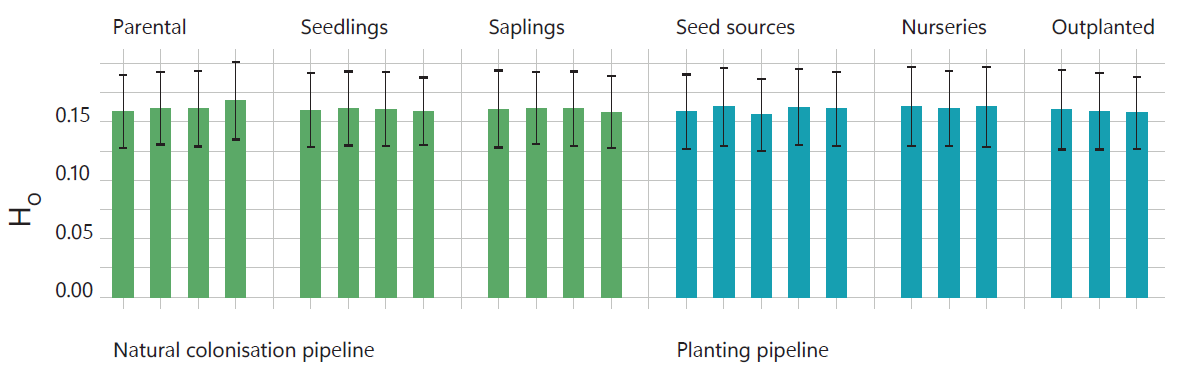
Figure 1: Levels of genetic diversity measured as observed heterozygosity (HO) in silver birch. Each bar represents a tree group from either natural colonisation or planting pipelines. Differences across groups are limited, indicating broadly similar genetic diversity across afforestation strategies.
Genomic tools also enabled us to identify levels of within- and between-group coancestry, inbreeding, and selection potentially caused by planting methods. Planted populations had significantly higher within-group coancestry, meaning trees at each site were more closely related to one another than in natural populations, which may result in a loss of genetic diversity in subsequent generations.
Between-group coancestry was also higher in several oak planted populations, potentially due to the use of a limited number of seed source stands.
This pattern reveals moderate genetic homogenisation, which could potentially reduce landscape complexity and adaptive differentiation among woodlands. In contrast, naturally colonised populations exhibited higher levels of recent inbreeding, probably due to fragmented landscapes.
Additionally, genomic analyses detected subtle signs of differential selection between planted and naturally colonised populations. For example, genes associated with flowering time, fruit detachment, and stress resistance showed evidence of selection, indicating unintended selective pressures in commercial tree production.
Health indicators, including deer browsing damage and disease incidence, were assessed at multiple sites to detect differences linked to planting versus natural establishment. Our assessments confirmed significant differences between afforestation strategies, with planted trees generally experiencing reduced browsing damage but differing levels of disease susceptibility.
For full details of our study, please read our paper: https://doi.org/10.1111/eva.70146
Considerations for policy
Our research presented several opportunities to improve management of genetic resources, which are outlined below.
Expand and diversify seed sourcing
The climatic breadth of current commercial seed stands inadequately represents the full bioclimatic diversity of wild populations. Investment in broader networks of registered seed stands and seed orchards would be beneficial for maintaining adaptive diversity.
Address fragmentation effects
Natural colonisation sites often experience elevated inbreeding. This is likely due to isolation and limited gene flow, resulting in a scarcity of parental trees contributing to the genetic pool of newly established populations. Policymakers should consider assisted gene flow, hybrid approaches combining planting with natural colonisation, and improvements in landscape connectivity to mitigate these effects.
Avoid planting populations of closely related individuals
Higher within-site relatedness in planted populations highlights the need to increase the number of regional seed sources and parental trees within commercial seed stands. This would reduce risks of future inbreeding and loss of genetic diversity. Within nurseries, there may also be opportunities to supply batches of saplings that explicitly mix offspring of different sources within a region.
Avoid genetic homogenisation
Higher between-site relatedness among planted populations at regional and supra-regional levels highlights the importance of using seeds from diverse local sources, potentially including the use of local orchards, to preserve genetic diversity across larger geographic scales and reduce the risk of genetic homogenisation.
Monitor for unintended selection
Subtle genetic signals suggest that current nursery and planting practices may inadvertently select for specific traits. Monitoring and review of nursery practices may be advisable to maintain resilience and adaptability.
Enhanced knowledge exchange and training
Collaboration between researchers, land managers, nurseries, and seed suppliers is essential to share best practices, address
genetic risks, and assist researchers in understanding the impacts of industry practice on research findings.
Further information
For further information, read our journal article or visit the Centre for Forest Protection website.
Friis, G., et al. (2025). Genetic consequences of tree planting versus natural colonisation: implications for afforestation programmes in the United Kingdom. Evolutionary Applications, 18(8), e70146.
How to cite this document
Centre for Forest Protection (2026) Genetic consequences of tree planting versus natural colonisation. Farnham: Forest Research.
https://doi.org/10.70463/OEZE6042
Research contacts
Guillermo Friis g.friis@kew.org
James Borrell j.borrell@kew.org
Royal Botanic Gardens
Kew
Richmond
Surrey
TW9 3AB
020 8332 5000
About the Centre for Forest Protection
The Centre for Forest Protection is a Defra-funded collaboration, led by Forest Research and Royal Botanic Gardens, Kew, which aims to protect our trees from environmental and socioeconomic threats, through innovative science, interdisciplinary research, expert advice and training.
Download a copy of this Policy & Practice Note:
Policy and Practice Note: Genetic Consequences of Tree Planting Versus Natural Colonisation (PDF)
Published: 28 August 2025.
Glossary & Key Terms
Adaptive differentiation/divergence
Genetic divergence among populations driven by selection in different environments, leading to locally adapted traits.
Assisted gene flow
Human-facilitated transfer of genetic material (e.g. seed or sapling transplants) between populations to bolster genetic diversity and climate adaptation.
Bioclimatic diversity
Variation in climate-related environmental conditions (e.g. temperature, rainfall, seasonality) across a species’ range.
Coancestry
Shared ancestry. Within-group coancestry measures average relatedness among individuals in the same population; between-group coancestry measures relatedness across different populations.
Commercial seed stands
Registered seed-producing tree stands used in afforestation efforts.
Differential selection
Variation in survival or reproduction among individuals due to trait differences, causing adaptive divergence over time.
Fragmented landscapes
Continuous ecosystems that are broken into isolated patches (often by human activity), reducing gene flow and increasing inbreeding risk.
Gene flow
Movement of genes across populations via migration of pollen or seeds, helping maintain genetic connectivity and diversity.
Genetic bottleneck
A sharp reduction in genetic variation caused by a significant decrease in the number of reproducing individuals. In the context of afforestation, collecting seeds from a limited number of parental trees within a larger population can lead to genetic bottlenecks.
Genetic diversity
Variation in genetic traits within a species or population.
Genetic homogenisation
Loss of genetic differences among populations, often reducing landscape-level complexity, which may result in reduced adaptability and resilience.
Genomic tools
High-throughput DNA sequencing and analysis methods used to assess genetic variation.
Inbreeding
Mating between related individuals, resulting in loss of genetic variation and increasing the chance of harmful recessive traits and reducing fitness.
Relatedness
Genetic similarity between individuals due to shared ancestry.
Share this project on social media
Our Partners


Social media
Explore
Newsletter
Contact
© 2026 Centre for Forest Protection. All rights reserved.