Published today (5 Dec 2025) in People and Nature, this research focuses on the loss of millions of elm trees, and ongoing efforts to bring them back. It emphasises that biological extinction is not the only form of ‘loss’. Functional traits and social or cultural connections also require restoration and regeneration but are often overlooked.
However, this paper suggests these should be given greater consideration in restoration projects as they may impact the success of restoration efforts.
Tree pests and pathogens are increasingly threatening trees, woodlands, and forests in Great Britain, as exemplified by both Dutch elm disease and ash dieback. Restoration of ash and elm is required to establish diverse, resilient treescapes.
Despite suffering a significant decline in numbers from the 1960s onwards due to Dutch elm disease, elm can still be found throughout much of Britain. However, they are rarely found as the large, mature trees which people once relied upon for timber for ships, houses, furniture and transport.
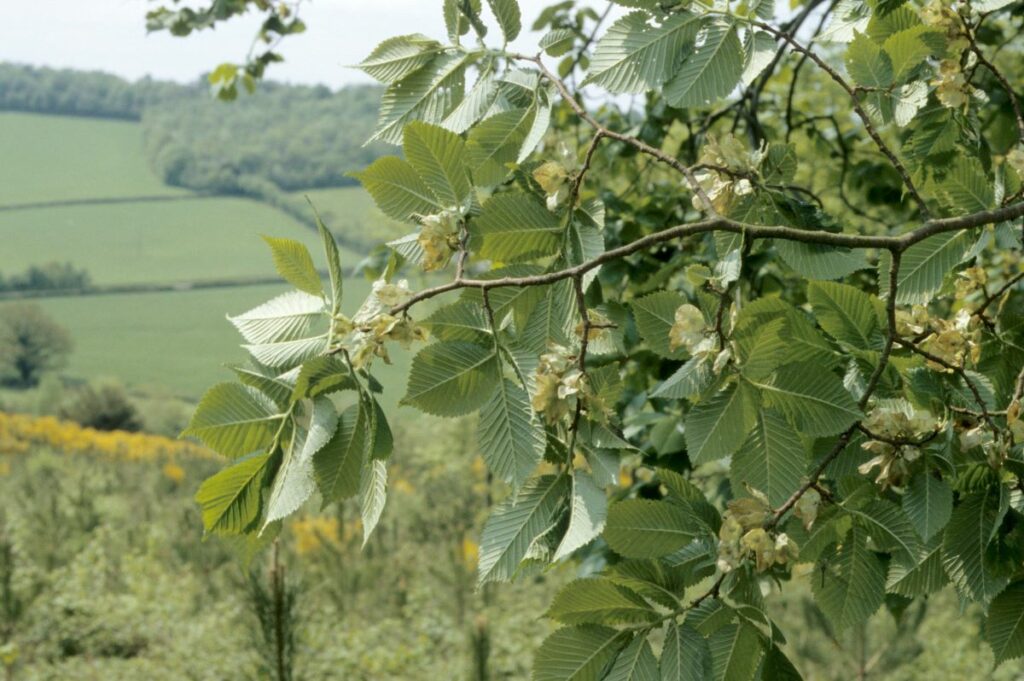
Leaves and seeds of a healthy wych elm © Crown copyright. Forestry Commission
In many areas they now remain only as small, scrubby hedgerow or understory plants, and public understanding and connection to elm species is at an all-time low.
There are exceptions to this, in refuge areas such as Brighton, which retains the National Elm Collection, and Assynt in the north of Scotland, where the disease has not yet reached. Many methods have been and are being developed to restore these important tree species, but all rely on re-establishing socio-cultural connections.
First Author of the paper, Fritha West, from the School of Geography and Sustainable Development at the University of St Andrews and the Centre for Forest Protection, said: “It is becoming increasingly clear that human intervention is necessary for the development of resistance to tree pests and pathogens.
“Even when resistance does evolve naturally, how we manage our woodlands will dictate the success of those young trees. There are lots of options out there, but they all lead to different outcomes, and how people feel about them varies – so we need to start the conversation now.”
The paper suggests there are social and cultural considerations for different elm management options, which should be given greater consideration in restoration projects as these may impact the success of restoration efforts.
Read the full press release from the University of St Andrews here: Communities and culture at the heart of ‘lost’ tree restoration | University of St Andrews news.
Access the journal article here: Social and cultural considerations for the restoration of ‘lost’ tree species: The fall and rise of elm – West – People and Nature – Wiley Online Library.
For more information on this research project, please see: Mapping attitudes and cultural connections to lost tree species and their restoration – Centre for Forest Protection.
Title image © Madeleine Allison
Stay connected!
Keep an eye on our website, follow us on social media (LinkedIn & Bluesky) and subscribe to our newsletter to be kept up to date on the latest CFP research, news and events!