
CFP Programme & Communications Officer Milly spent two days shadowing Forestry Commission Woodland Resilience Officer Jon Burgess in the late summer to learn about how research informs woodland management decisions in the face of climate change. Find out more about what she learned below…
As CFP Programme & Communications Officer, much of my role is spent working with our project teams to understand more about their research, and how best I can support the promotion and dissemination of their findings. Whilst I love this role and find the research absolutely fascinating, getting to spend time away from my desk and out in the field is always welcome!
And so earlier this year, I signed up to the CFP Work Shadowing Programme pilot, with the aim of learning more about how research is applied in practice, with a particular focus on enhancing forest resilience. Work shadowing is available to researchers and others directly involved with the CFP, and the pilot involves a small number of placements so we can test the process.
I was paired with Jon Burgess, one of the Forestry Commission’s Woodland Resilience Officers, and after chatting via email about what I wanted to get out of the experience, we agreed to head out to a couple of sites near Bristol at the end of August.
From species trials and provenance testing to practical woodland management, I saw first-hand how research underpins the principles of the Resilience Implementation Framework and helps build more resilient woodlands for the future.
Day 1 – Westonbirt Arboretum
On the first day, we headed over to Westonbirt Arboretum, where we began by exploring the Forest Research (FR) Emerging Species¹ Trial plots which were planted in 2012-13.
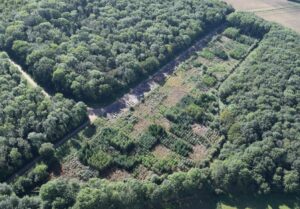
Forest Research species trials, Westonbirt Arboretum in 2019 © Crown Copyright. Forestry Commission. (click to enlarge).
The Emerging Species Programme was established to identify tree species and provenances² that could help improve the resilience of Britain’s forests as they face increasing threats from climate change, including drought, pests and diseases, wildfire, and wind damage. The programme builds on decades of previous species trials.
Discussions during our visit highlighted that forest resilience is not necessarily about preventing change but managing it by focusing on the wider woodland ecosystem and the natural capital it provides, from biodiversity and habitat to carbon storage and soil protection. By testing a wide range of species, Forest Research is helping woodland managers to make evidence-based decisions that will support resilient, productive forests in the future.
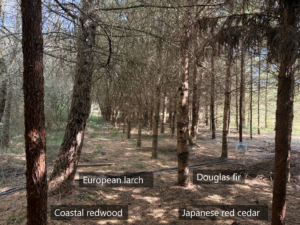
The intersection of a number of species plots at Westonbirt (click to enlarge).
A variety of emerging species were trialled here over a five year period, including Japanese red cedar (Cryptomeria japonica) which seemed to be performing considerably better than some of the other species, showing good survival, strong growth rates, straight stems and natural self-pruning, all desirable traits for timber production.
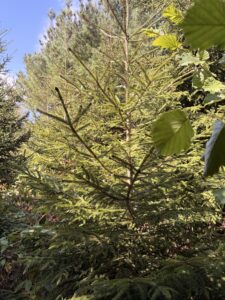
Oriental spruce (Picea orientalis).
In contrast, species such as oriental spruce (Picea orientalis) appeared less well suited to conditions at Westonbirt, with poorer growth rates. Walking through these trial plots really highlighted the importance of long-term research to understand how different species are responding to our changing climate and environmental conditions. As someone who usually encounters this type of work through research summaries and project updates, seeing the trials in person really brought the scale and long-term nature of this research to life.
You can find out more about the FR Emerging Species Trials here:
- Priorities for research on emerging species: An analysis based on species diversity in present and future environments – Forest Research Report
- Providing the evidence base to diversify Britain’s forests: initial results from a new generation of species trials – Royal Forestry Society Technical Paper
We then spent the afternoon looking at the REINFFORCE³ experimental plots. This European project established a network of 38 experimental sites stretching from Portugal to Scotland, creating a unique opportunity to investigate how different tree species and provenances respond to current and future climate conditions. It was really interesting to compare trial plots containing the same tree species but grown from seeds from different provenances. Seeing these side-by-side highlighted that resilience is not only about selecting the right species, but also choosing seed from provenances suited to future site conditions.
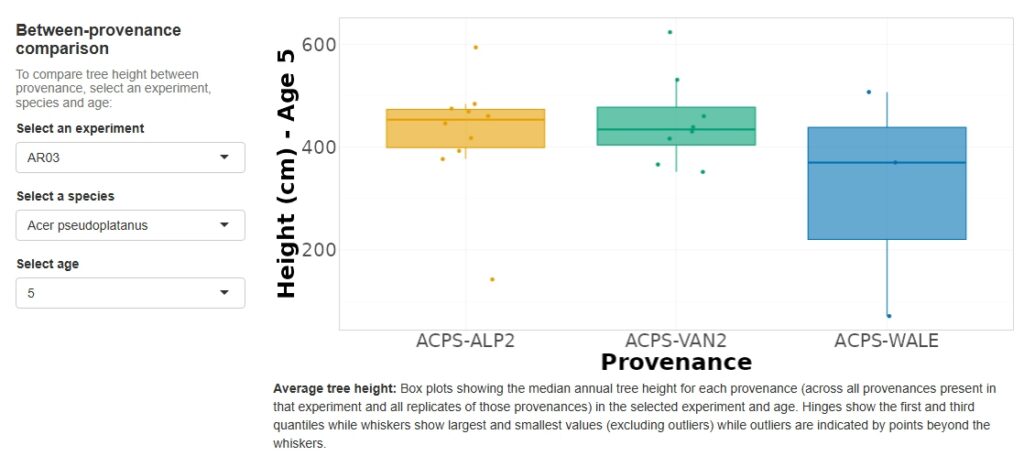
Figure 1 Between-provenance comparison of Sycamore (Acer pseudoplatanus) at Westonbirt (experiment AR03). ACPS = Acer pseudoplatanus; ALP = Alps and Jura mountain regions, France; VAN = Montes Vasco-Navarros (Basque Mountains), Spain; WALE = Wales. Source: Explore REINFFORCE data set (up to age 5).
Figure 1 shows a comparison of sycamore provenances at Westonbirt after five years of growth. Even at this early stage, the Welsh provenance (blue) was performing less well than the French (yellow) and Spanish (green) seed provenances. When Jon and I visited the plots approximately 13 years after planting, these differences appeared even more obvious. The Welsh trees seemed to be struggling, likely reflecting the challenges of adapting to warmer and drier conditions, whereas the French and Spanish provenances appeared better suited, likely because they were more genetically ‘used to’ these conditions. There were also many other examples of tree species across these research plots whose growth had vastly differed between provenances.
Projects like REINFFORCE are providing extremely valuable insight for future forest management, helping woodland managers to make informed decisions about how to create diverse, resilient forests capable of continuing to deliver timber, biodiversity, carbon storage and other natural capital in a changing climate. This reflects the objectives of the Resilience Implementation Framework, which highlights the use of evidence, species and structural diversification and adaptive management to strengthen resilience in the face of future uncertainty.
Whilst the trials at Westonbirt demonstrated how research is helping us to understand future resilience challenges, our second day at an Estate in South Gloucestershire gave me the opportunity to see how woodland managers apply these principles on the ground.
Day 2 – Woodland management in practice
On day two, we were joined by Robbie Barnes, a Forestry Commission Field Manager, on a trip around an Estate to learn more about what resilience means in practice, the various climate threats facing this site, and the management options available to them. Throughout this visit, we focused on Steps 4 and 5 of the Resilience Implementation Framework: identifying appropriate management actions, and monitoring outcomes over time. As we worked our way around the Estate, we discussed how resilience is not about finding a single solution, but about balancing site conditions, climate threats, management objectives, and the benefits that woodlands provide.
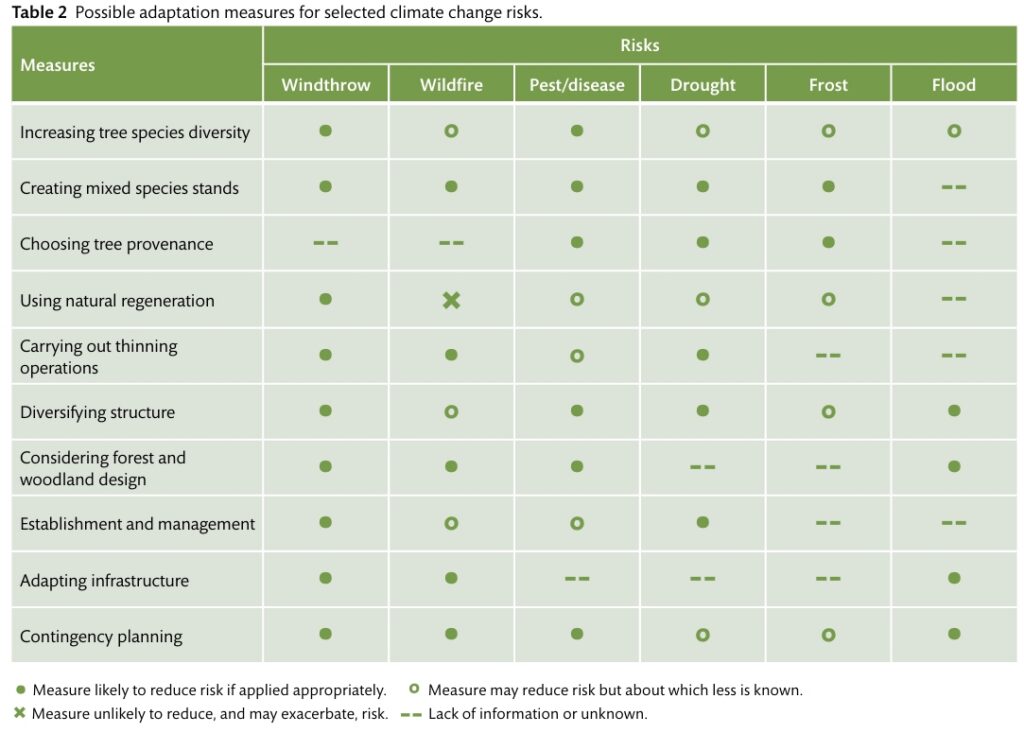
Possible adaptation measures for selected climate change risks, taken from the UKFS Practice Guide: Adapting forest and woodland management to the changing climate (page 19).
We began by discussing Countryside Stewardship Higher Tier (CSHT) agreements and the woodland supplements available to support long-term environmental management. The Estate has applied for the Improve Woodland Resilience supplement, which requires them to increase both species diversity and structural diversity within their woodlands. This aligns closely with the recommendations set out in the UKFS Practice Guide Adapting forest and woodland management to the changing climate, which identifies measures such as species diversification, thinning, structural diversification and contingency planning as important tools for increasing resilience to future threats.
But how is this done in practice?
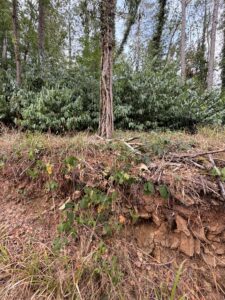
Thin, stony soils.
Whilst diversifying structure and species is important for forest resilience, the silvicultural complexity increases as more species are added into the mix. Different species compete for light, water and nutrients, and managers need a strong understanding of silviculture to ensure that mixed-species stands develop successfully. At the Estate, existing site conditions also influence management decisions- their thin, stony soils hold relatively little moisture, increasing vulnerability to drought, and for the trees on top of the ridges around the Estate, thin soils also increase vulnerability to windthrow. Furthermore, there are large areas of larch and ash which bring additional risks from Phytophthora and ash dieback.
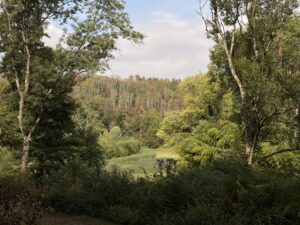
Larch and ash stand in the background.
Rather than waiting for disease outbreaks to occur, resilience-focused management seeks to act early. In some stands, Jon explained how gradual thinning could create opportunities for underplanting more resilient species beneath existing larch or ash canopies. The mature trees act as “nurses”, providing shelter, shade and protection for younger trees whilst diversification takes place. This approach can help woodlands adapt gradually rather than relying on large-scale intervention, such as clear felling. It also avoids waiting for disaster to strike before taking action. If disease or another disturbance affects the overstorey, the underplanted species are already established and can more quickly develop into a new canopy. This ability to maintain woodland cover and return more quickly to a stable state is at the heart of resilience.
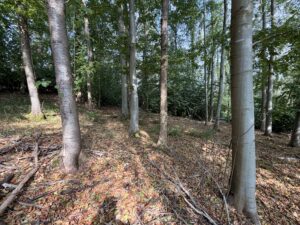
An example of species structural diversification in the Estate – in this image, there are cherry, beech, oak and ash trees!
A recurring theme throughout the day was that resilience depends on understanding the objectives of a site. At the Estate, woodland management must support a range of functions, including biodiversity conservation, maintaining the historic landscape, generating timber income, providing educational access, and creating an attractive setting for the Estate’s wider activities, such as hosting weddings and events. Therefore, the challenge is not just deciding which trees to plant but determining how woodland structure and species composition can best deliver these multiple forms of natural capital into the future.
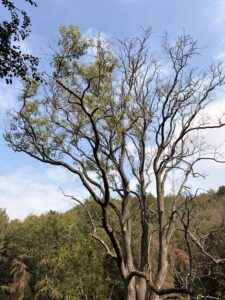
An ash tree suffering from dieback.
Walking around the Estate also reinforced the importance of monitoring and learning. Evidence of ash dieback, declining oak trees and invasive species such as cherry laurel highlighted how quickly woodland conditions can change. Management plans cannot remain static; they must evolve in response to emerging threats, changing site conditions and new evidence. This continuous cycle of observation, learning and adaptation lies at the heart of the Resilience Implementation Framework and is essential if woodlands are to remain healthy and functional in a changing climate.
The Tortworth Chestnut
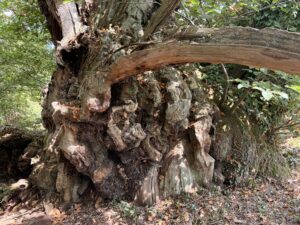
The trunk of the Tortworth Chestnut.
To round off our days in the field, we visited the Tortworth Chestnut, reported to be one of the oldest planted trees in England, to learn about ancient and veteran tree management. As an irreplaceable keystone structure, resilience planning focuses on mitigating threats like climate change, soil compaction, and habitat fragmentation.
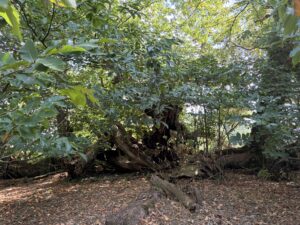
It was impossible to get a photo that captured the scale of this tree – if you are ever in the area, make sure to visit, pictures just don’t do it justice!
We finished up with a well-deserved slice of cake to celebrate Jon’s birthday that he had very kindly given up taking me out in the field!
As someone with a couple of years’ experience in forestry communications, but with a more generic geographical academic background, spending time in the field with Jon and Robbie was incredibly eye-opening. Seeing the journey from research trials and evidence generation through to practical woodland management decisions over the space of just two days helped me better understand how research translates into real-world action.

Rounding off our two days in the field with cake for Jon’s birthday!
The experience really highlighted the value of bringing together people working across research, policy and practice, and I hope it encourages others across the CFP programme to get involved, either as a participant or a host!
All images taken by Milly Bell (© Crown Copyright. Centre for Forest Protection) unless otherwise stated.
¹Emerging Species is a term defined as species and provenances that have been identified as having potential for more extensive planting in the United Kingdom.
²Provenance refers to the original geographic and genetic evolutionary home of the parent population. This is different to a seed source, which is the specific geographic location from which seeds are harvested. For example, you could get a French provenance oak from a British seed stand and nursery.
³REINFFORCE stands for REsource INFrastructure for monitoring and adapting European Atlantic FORests under a Changing climatE.
Stay connected!
Keep an eye on our website, follow us on social media (LinkedIn & Bluesky) and subscribe to our newsletter to be kept up to date on the latest CFP research, news and events!