
It’s been a busy and exciting summer for the Centre for Forest Protection (CFP). In last week’s blog, we highlighted the vital fieldwork that took place our projects which you can read here: A summer of discovery: How CFP researchers are strengthening forest resilience.
This week, we celebrate the many ways our researchers have been sharing their work beyond the field this summer, from presenting at conferences to appearing on the BBC. Read on to learn more about the project teams spreading the word about CFP research and two of our scientists who were interviewed about their work protecting the nation’s trees and forests.
REWARD project: Metabolomics conference, Buenos Aires, Argentina
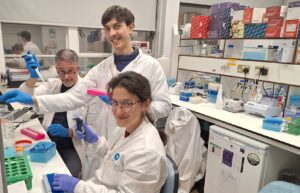
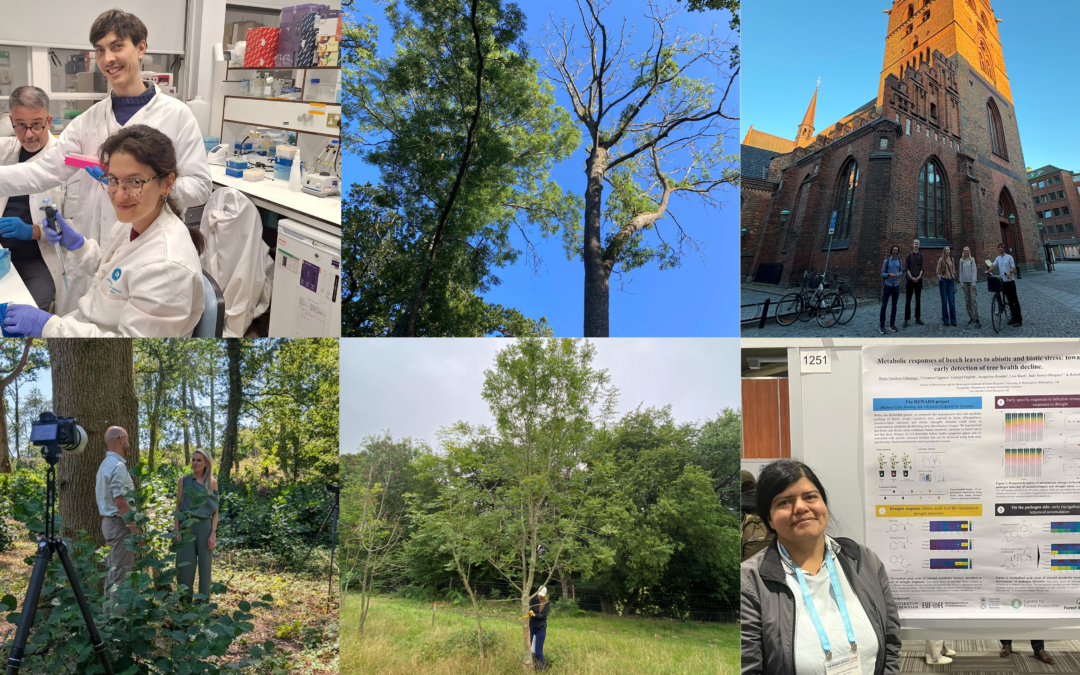
Practical workshop carried at the School of Biosciences (University of Birmingham) with members of the REWARD project from Forest Research, University of Swansea, and University of Birmingham © Crown Copyright. Centre for Forest Protection; University of Birmingham.
Over the past year, our REWARD project have worked to develop tools that detect early stress in trees. To this end, they have conducted hyperspectral and metabolomics analyses on different tree species. From the metabolomics analysis, they identified metabolites that change under biotic (pathogen) and abiotic (drought) stress at both early and late time points. They will correlate these metabolites with hyperspectral data and continue monitoring them in current polytunnel experiments.
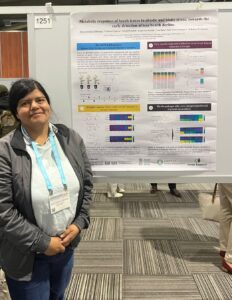
Dr Diana Vinchira-Villarraga presenting REWARD project results during the poster session at the 22nd Metabolomics conference (Buenos Aires, Argentina- June 2026) © Crown Copyright. Centre for Forest Protection; University of Birmingham.
The team presented their data at the Metabolomics Society conference in Buenos Aires, Argentina, in June and gained helpful insights and further analysis advice, which they plan to apply to the current experiment to expand their understanding of how trees cope with stress.
The project team also hosted undergraduate student Louisa as part the Royal Society of Biology’s Plant Health Undergraduate Studentship programme throughout the summer. Read Louisa’s reflections here: Louisa’s Royal Society of Biology Studentship with the Centre for Forest Protection.
Ash genomics project: FraxNet conference, Malmö, Sweden
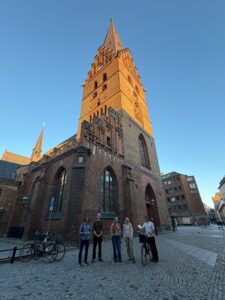
Pictured (left to right): Dr Dario Galanti (RBG, Kew), Oliver Stock (Future Trees Trust), Dr Laura Kelly (RBG, Kew), Phoebe Swift (RBG, Kew), and Dr Robert Taylor (Defra), enjoying golden hour at St. Petri Church, Malmö, Sweden © Future Trees Trust, Dr Jo Clark.
In August, RBG Kew researchers from our Investigating ash health genomics after long-term ash dieback exposure project team travelled to Malmö, Sweden, to attend the 2026 FraxNet conference, bringing together researchers working to protect ash (Fraxinus) across Europe and America. Talks covered everything from genomics in disease resistance to woodland ecology, breeding and natural regeneration. A recurring message was one of cautious optimism: although ash trees continue to face severe threats from the ash dieback fungal infection and the emerald ash borer invasive beetle, research into resilient trees, alongside careful woodland management and maintaining genetic diversity, offers ways to help protect ash for the future.
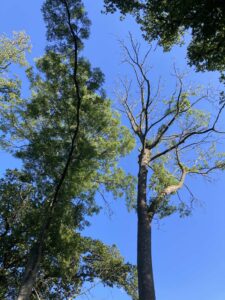
Ash trees at Dalby Söderskog National Park in Sweden © Crown Copyright. Centre for Forest Protection; RBG, Kew – Dr Laura Kelly.
The team also had the opportunity to visit ash breeding orchards across Denmark and Sweden, seeing first-hand how trees showing natural resilience to ash dieback can be selected and tested for future planting.
CFP PhD student Phoebe Swift presented the team’s recent genomic analysis of UK European ash (Fraxinus excelsior) populations, which led to some really interesting questions and discussions. It was a fantastic opportunity for the team to share their work with the international ash research community, learn from researchers working on ash conservation around the world, and see how research is being translated into practical approaches for the future of this important tree.
Risks to non-native tree species project: Arb Association conference, Lancaster, England
In early September, Dr Laura Kelly, who leads our Predicting risk to non-native tree species from potential threats in the UK project, gave a presentation at the Arboricultural Association Conference 2026 held at Lancaster University.
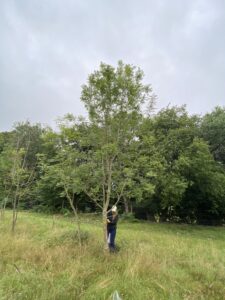
Dr Laura Kelly during fieldwork for ongoing CFP ash genomics research © Crown Copyright. Centre for Forest Protection; RBG, Kew – Phoebe Swift.
Her talk focused on how the global movement of both trees and harmful organisms has increased the risk of pests and diseases spreading to new hosts, sometimes with devastating consequences such as ash dieback and emerald ash borer infestations. Laura outlined how evolutionary relationships between tree species can be used to predict which new host-pest and host-pathogen interactions are most likely to occur, as closely related species are more susceptible to sharing threats.
She highlighted the development of modelling approaches that use these evolutionary patterns to assess risks to oak species worldwide and to lesser-known tree species that may play a role in future UK planting schemes. These predictions can help prioritise action against emerging pest and disease threats and inform the selection of resilient tree species for future forests and landscapes.
Media appearance: BBC Landward – elm restoration
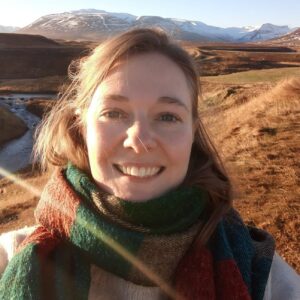
Fritha West, CFP PhD Researcher
Earlier this summer, CFP PhD researcher Fritha West had the opportunity to be interviewed by Landward, BBC Scotland’s farming and countryside programme.
In the programme, Fritha discusses why many of the elm trees around Assynt, Scotland have survived despite millions of mature elm trees being lost due to Dutch elm disease (DED) since the 1970s, and how best to protect these trees in our changing climate. She also highlights the University of St Andrews-funded Elm Action Map, which was established as part of the Assynt Elm Project, led by writer Mandy Haggith. Creation of this interactive online ‘StoryMap’ was and brought together many people who have been working to protect elm in different ways. The StoryMap features stories about elm trees in Assynt, and people’s connections to them, to further promote appreciation for and protection of these trees.
Watch the episode here: BBC Landward 2026: Episode 10.
Unfortunately, since the programme was broadcast, DED has now been detected in Assynt. All is not lost and the community are currently exploring options on how best to manage this. Please contact Culag Community Woodland Trust if you would like to help.
If you are interested in learning more about Fritha’s research, you can read more about her PhD research: Mapping attitudes and cultural connections to lost tree species and their restoration and watch a recording her recent webinar: Perspectives on the ecological and cultural restoration of elm in Britain webinar – YouTube | Centre for Forest Protection.
Media apperance: BBC Tech Now – Wind within the trees
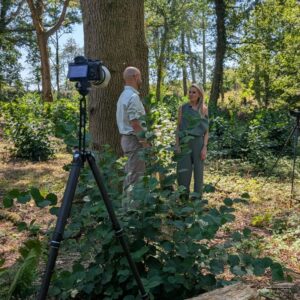
Dr Tom Locatelli and Lara Lewington (BBC Tech Now) during filming for the interview at Wakehurst © RBG, Kew.
In May, Kew Wakehurst celebrated the fifth anniversary of their Nature Unlocked programme. As part of these celebrations, they also announced new research collaborations with other organisations, including working with the CFP on our Wind within the trees project.
Windstorms are Europe’s most damaging abiotic (non-living) threat to woodlands and can have significant impacts on livelihood and wellbeing. However, there is currently limited understanding of the potential for CCF to reduce these impacts. This project is exploring multiple perspectives on cultural attachment to different forest species and woodland types, perceptions of wind risk, and the feasibility of CCF as a management strategy. Project lead, Dr Tom Locatelli, along with researchers from other new studies at Wakehurst, was invited to speak to BBC Tech Now about the team’s work, and the interview was broadcast on 12 September 2026, on BBC Breakfast and BBC News channels.
Watch the interview here: BBC Tech Now – Can New Tech Help Assisted Births? – BBC iPlayer(Don’t be confused by the programme title – skip to 17:30 mins to watch the piece on Kew Wakehurst!)
–
We are delighted that so much fascinating research, fieldwork, and engagement has been going on throughout the summer- far more than we can cover in these blogs! A huge thank you to all of the research teams who contributed to this piece, and to everyone across the CFP network for your continued hard work in supporting our trees and forests!
Stay connected!
Keep an eye on our website, follow us on social media (LinkedIn & Bluesky) and subscribe to our newsletter to be kept up to date on the latest CFP research, news and events!