Tomorrow (Saturday 21 March 2026) is International Day of Forests (IDF), which aims to celebrate and raise awareness of the importance of all types of forests.
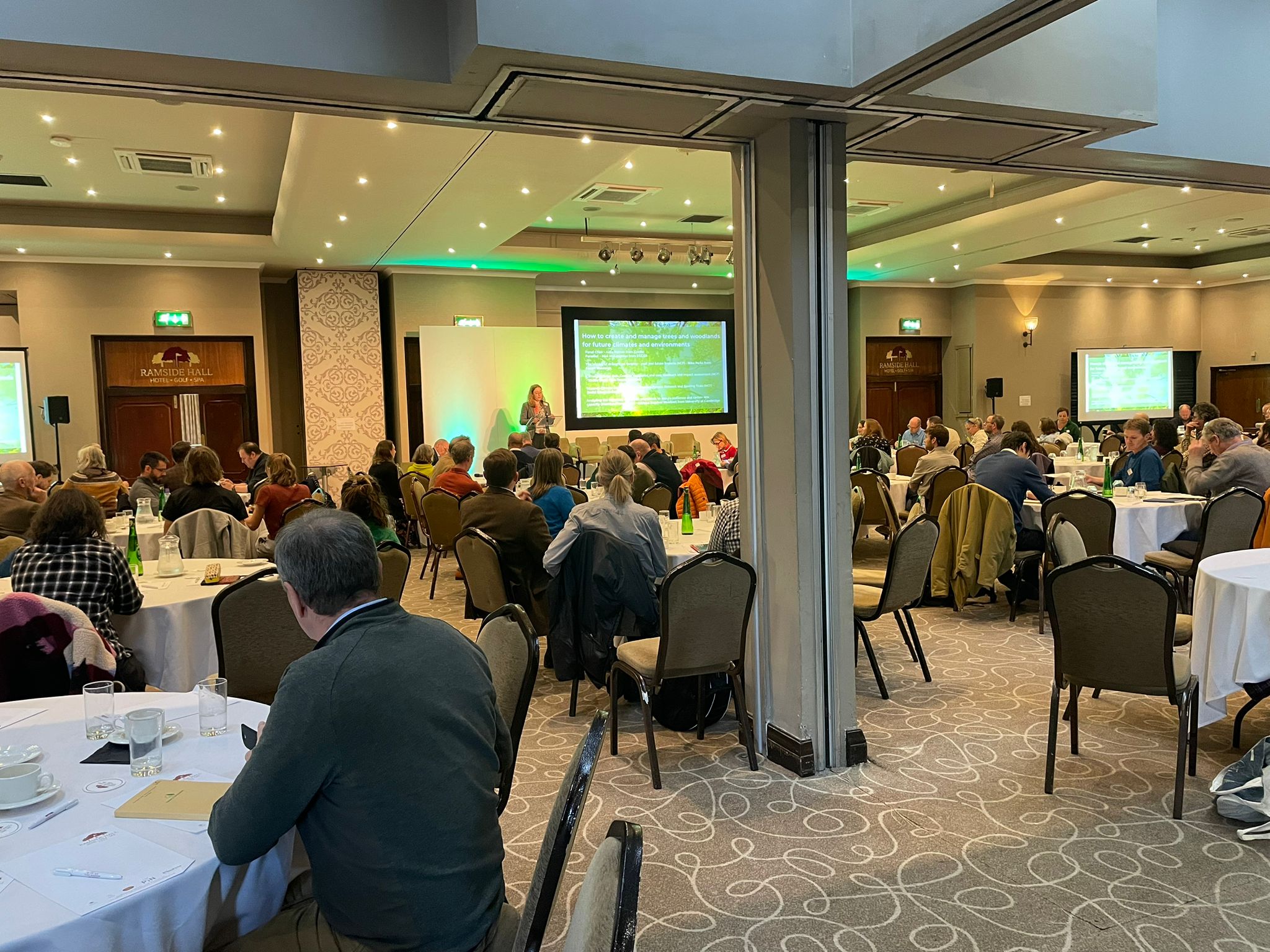
To celebrate, we are publishing several of the talks given by Centre for Forest Protection researchers at the ‘Britain’s Forest Future: Research-Practice Exchange’ conference which was held in Durham in November 2025. Access each of the talks below, or via our YouTube channel.
Organised by the Centre for Forest Protection (CFP), Defra, and the Future of UK Treescapes, Britain’s Forest Future brought together practitioners, policymakers, researchers, and professional bodies from across the forestry, tree, and plant health sectors. The event featured two keynote speeches, eighteen different sessions, and almost 100 speakers and panellists.
The event began with a keynote speech from Professor Bianca Ambrose-Oji, Chief Scientist at Forest Research, who outlined the importance of researchers, policymakers, practitioners, and others across the sector working together to increase forest resilience.
Across the two day event, we heard from a number of researchers representing some of our CFP Phase 1 projects.
Centre for Forest Protection Research Highlights:
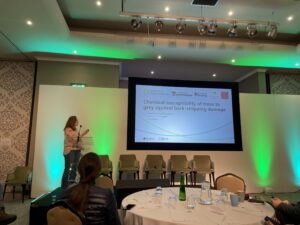 Dr Alexandra Ash, Mammal Ecologist at Forest Research, and one of the researchers on our project Understanding the drivers of grey squirrel damage in UK Woodlands, gave a talk on her recently completed PhD at the University of Southampton, which aimed to understand the drivers of bark stripping by grey squirrels in UK woodlands.
The project team found that certain natural chemical compounds produced by trees can influence grey squirrel behaviour, repelling them when the compounds come from resistant trees and attracting them when from susceptible ones, suggesting these chemicals could be used to help protect woodlands from bark-stripping damage. Watch Alex’s talk here:
–
Dr Nathan Brown, Environmental Modeller at Forest Research, and one of the project leads on our Using spatial modelling to understand environmental predisposition to tree diseases project gave a talk on the use of spatial modelling to understand environmental predisposition to tree diseases.
The key takeaway from this talk was that understanding how environmental conditions relate to pest and disease occurrence can help identify high‑risk areas and guide surveillance, but these correlations must be tested experimentally and continually updated through monitoring to ensure accurate predictions in a changing climate. Watch Nathan’s talk here:
–
 Dr Laura Kelly, Research Leader at Royal Botanic Gardens, Kew and one of the project leads on our Predicting risk to non-native tree species from potential threats in the UK project, gave a talk on predicting pest and disease threats to non-native trees in the UK.
The research highlights that existing data can be used to predict and prioritise the highest‑risk new pest and disease interactions, helping inform future tree species choices and guide targeted monitoring of current plantings. Watch Laura’s talk here:
–
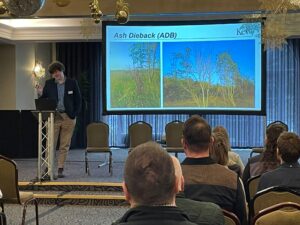 Dr Daniel Wood, Future Leader Fellow at Royal Botanic Gardens, Kew and one of the project leads on our Transforming ash genomics: Creating a pangenome to understand ash dieback resistance project, gave a talk on his research on genomic approaches to ash dieback.
A key takeaway from this research is that ash dieback resistance appears to be partly heritable and influenced by many small genetic variants, meaning it may be possible to predict healthier trees as natural selection continues in the wild. Watch Daniel’s talk here:
–
 Dr Rômulo Carleial, Post-Doctoral Research Associate at Royal Botanic Gardens Kew, and member of our Understanding the genetic basis of silver birch adaptation to local environments and disease project team, gave a talk on genetic basis of traits and local adaptation in UK silver birch.
The project found that silver birch provenances show complex patterns of performance, southern origins often grow well and many traits are shaped by many genes, yet evidence of local adaptation and unexpectedly strong performance in harsher environments suggest that predicting suitability is not straightforward. Watch Rômulo’s talk here:
–
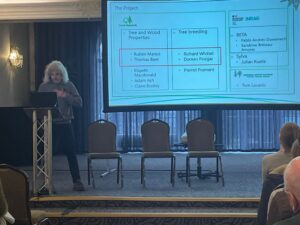 Dr Rubén Manso, Senior Scientist at Forest Research, and one of the project leads on our Identifying proxy measurements for drought tolerance in Sitka spruce project gave a talk on using available genetic resources to build economic resilience: the case of Sitka spruce.
The research found that while breeding for drought tolerance looks promising, maintaining broad genetic diversity remains a precautionary strategy, and Sitka spruce could serve as a useful model for developing resilience‑testing methods that can later be applied to other species. Watch Rubén’s talk here:
–
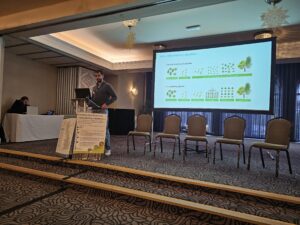 Dr Guillermo Friis, Post-Doctoral Researcher at Royal Botanic Gardens, Kew and one of the project leads on our Evaluating genetic and environmental bottlenecks in planted and naturally colonised woodlands project gave a talk on evaluating genetic diversity and tree condition in planted & naturally colonised young woodlands.
The key finding from this piece of research was that both natural regeneration and planting can build resilient woodlands, but managing genetic risks through thoughtful seed sourcing and mixing provenances is essential to maintain diversity and adaptive potential under a changing climate. Watch Guillermo’s talk here:
–
The final keynote was delivered by Dr Justine Bejta, Deputy Chief Scientific Advisor and head of the Central Science Division at Defra, who discussed the importance of embedding research in forestry practice.
 You can access recordings of all of these talks via our YouTube channel: https://www.youtube.com/@centreforforestprotection