
‘Invasive Species Week’ is an annual awareness campaign led by the GB Non-Native Species Secretariat, to highlight the environmental and economic threats posed by invasive plants and animals, and to educate the public on how to prevent their spread.
What is a non-native species?
A non-native species (NNS) is an organism which has been introduced to an area outside of its native range. They can be spread deliberately, for example by people bringing NNS back to the UK from abroad, or inadvertently, for example by propagules (including eggs, seeds, and spores) being spread on or by equipment, vehicles and clothing or in the movement of soil, water, or garden waste. Over 2,000 different plants and animals have been introduced to Britain from all over the world primarily through human activity.
What is an invasive non-native species and how does it differ from an NNS?
The majority of NNS do not cause any negative impact in the area they have been introduced to. However, around 10-15% of NNS become invasive non-native species (INNS) which can cause devastating impacts. An example of an INNS in the UK is the grey squirrel, which is having a significant impact on our woodlands and native red squirrels.
“Invasive non-native species are one of the top five drivers of global biodiversity loss and play a role in 60% of plant and animal extinctions. They cost the global economy over $423 billion a year and their costs have quadrupled every decade since 1970. Here in GB, they threaten the survival of native wildlife, damage our natural ecosystems, cost the economy nearly £2 billion a year, and can even harm our health and interfere with activities we enjoy.” – GB Non-Native Species Secretariat.
What is the CFP doing to manage the impact of INNS on our treescapes?
There is a lot of research going on across the CFP focusing on a variety of INNS. Here are just a few examples:
Grey squirrels (Sciurus carolinensis)
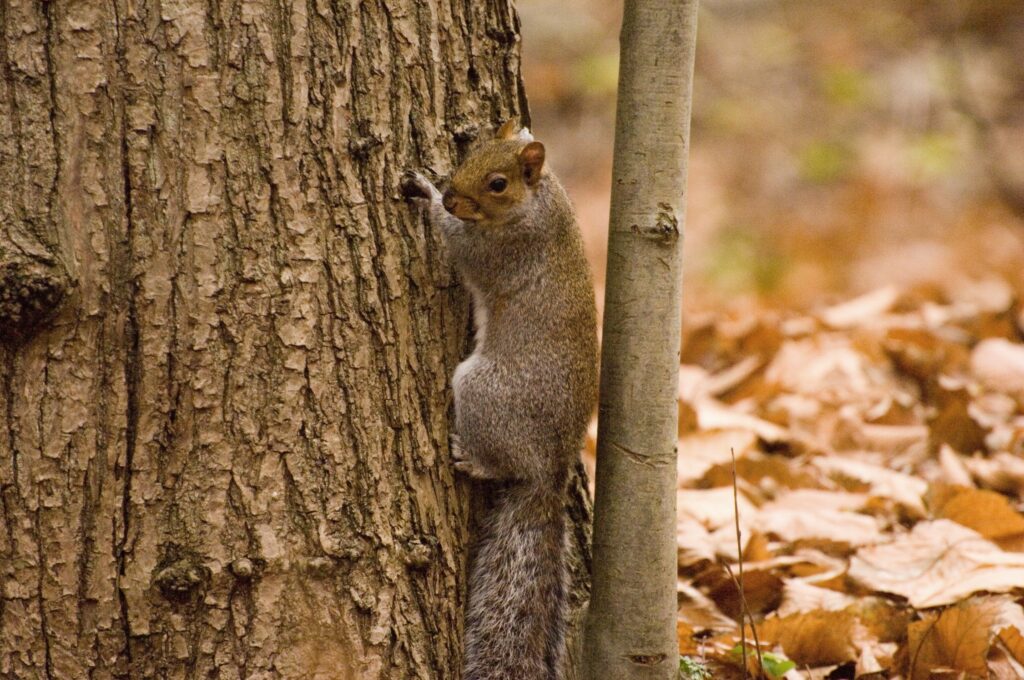
Grey squirrel on a sweet chestnut tree © Crown Copyright. Forestry Commission – Isobel Cameron.
Grey squirrels are an INNS that has spread widely across the UK since being introduced to England from North America in the late 19th century. They pose a major threat to our native red squirrels (Sciurus vulgaris), which are classified as endangered in England and Wales and near threatened in Scotland, through competition for food and the transmission of the squirrel pox virus, which is typically harmless to grey squirrels but often fatal to reds.
Grey squirrels also pose a severe challenge to the sustainable management of woodlands, with the economic cost of their damage being estimated at £37 million per year in England and Wales, not including costs to our biodiversity. One of the main ways they damage woodlands is by stripping bark from trees, which can lead to tree death in extreme cases. It is still not fully known why grey squirrels bark strip, but some of our researchers are trying to develop a better understanding of this behaviour.
Our Phase 1 project Understanding the drivers of grey squirrel damage in UK Woodlands aimed to understand the drivers and motivations behind why grey squirrels bark strip. The follow-up Phase 2 project Understanding grey squirrel bark stripping is building on this research by trying to identify which chemicals in tree bark appeal to grey squirrels. The researchers are also aiming to develop a collar which can track the squirrels’ movement amongst tree canopies in 3D, to help them to characterise bark stripping behaviours.
A toolkit for studying grey squirrel bark stripping behaviour will also be established throughout the course of the project, which will support woodland management.
Emerald ash borer (Agrilus planipennis)
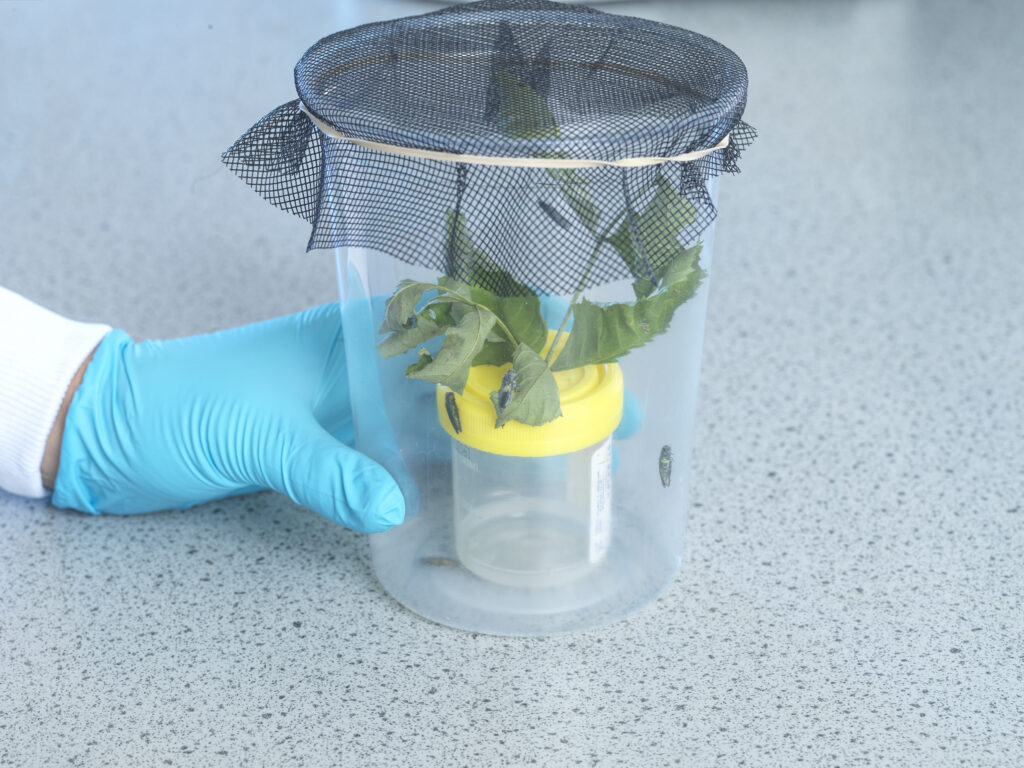
Emerald ash borer adults feeding on ash leaves in the Holt Containment Facility © Crown Copyright. Forest Research – Andrew Brookes.
The emerald ash borer (EAB) beetle is a pest of ash trees (Fraxinus species). Whilst not currently present in the UK, its westward spread from its native range in Asia into continental Europe is concerning, and if it were to become established in the UK, it would further increase the risk to our native ash trees which are already being significantly threatened by Ash dieback (ADB) disease.
Our Dodging the double whammy – ash dieback and emerald ash borer project is looking at the potential threat that the EAB beetle could cause as an INNS, alongside ADB, were it to be introduced to the UK. Previous research has suggested that ADB, which is widespread in the UK, could worsen the damage caused by the EAB.
Our researchers are aiming to assess whether ash trees that have some natural resistance to ADB are also resistant to the impacts of the EAB. This will help inform UK government strategies for breeding ADB-resistant ash trees and for managing the EAB if it is introduced to the UK. Further information about the beetle and how to report any concerns is available here: Emerald ash borer beetle (Agrilus planipennis) – Forest Research.
Invasive non-native fungal species
Whilst invasive non-native animal and plant species can have a substantial impact on our treescapes, there are also a large number of invasive non-native fungal species which pose a significant risk to our woodlands too. Here are two examples of CFP projects which are looking into the effects of fungal diseases:
Ash dieback
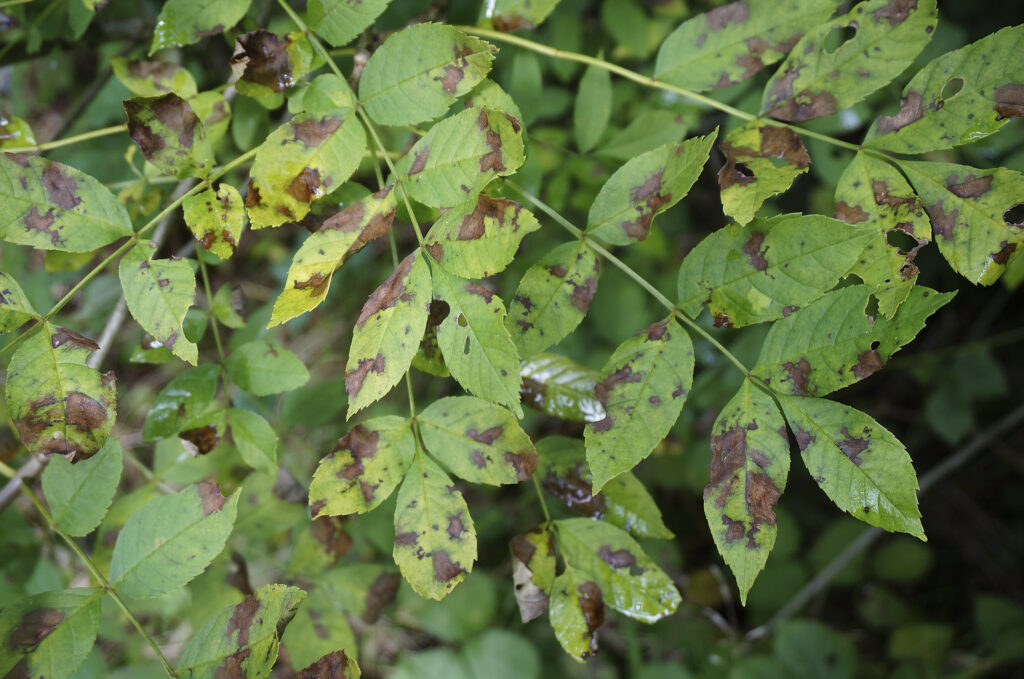
Ash dieback infected leaves showing leaf lesions © Crown Copyright. Forest Research – Ana Perez-Sierra.
Ash dieback is caused by an INNS fungus called Hymenoscyphus fraxineus which originated in eastern Asia and was first identified in Europe in the 1990s. It is the most destructive tree disease in the UK since Dutch elm disease and can kill up to 90% of affected ash trees, leading to severe ecological, economic and safety impacts across woodlands, hedgerows, and urban landscapes. As the third most common broadleaved tree in Britain, ash supports over 1,000 organisms and the loss of this species threatens the survival of rare bryophytes (mosses), lichens, and insects that depend entirely on it.
Our Investigating ash health genomics after long-term ash dieback exposure project aims to better understand how natural ADB-resistance works over time, and to develop a range of tools that can predict how resistant a tree may be to ADB just by looking at its DNA.
This work will help to identify the best (i.e. most resistant) ash trees to use in breeding programmes, and builds on work from The Living Ash Project as well as previous CFP projects Consolidating and curating datasets for ash genomics and Transforming ash genomics: Creating a pangenome to understand ash dieback resistance.
Dothistroma needle blight
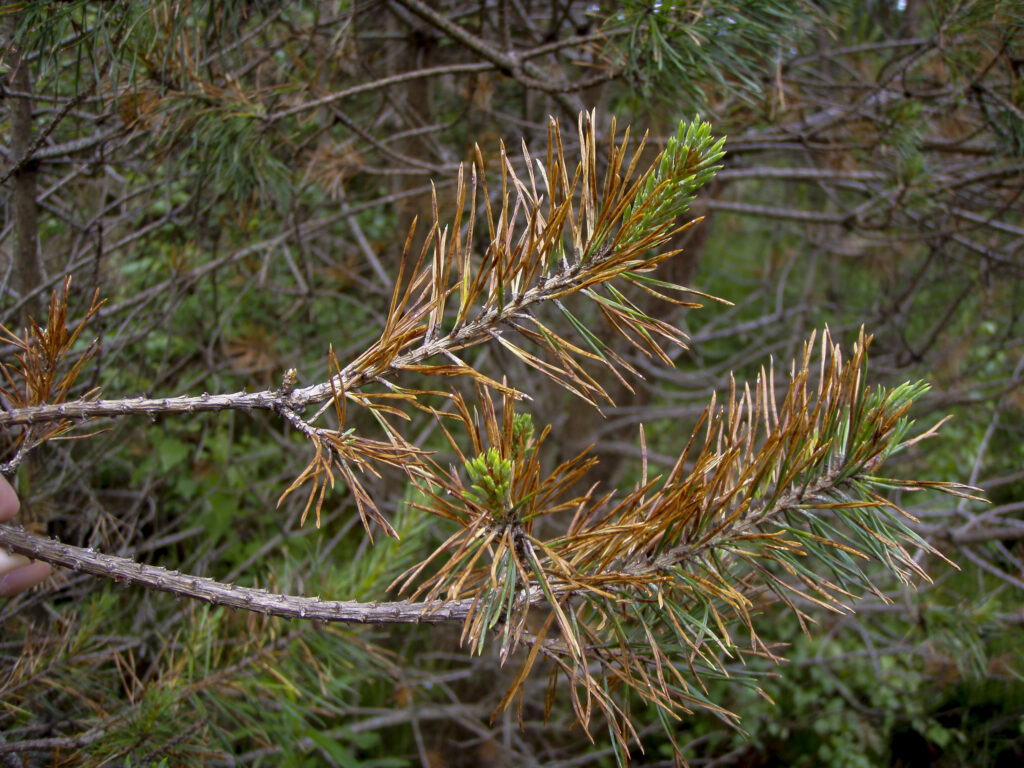
Dothistroma needle blight on Scots pine branches © Crown Copyright. Forest Research.
Dothistroma needle blight (DNB) is a disease of conifer trees, particularly pines, caused by the INNS fungus Dothistroma septosporum. Infected needles develop yellow and tan-coloured spots and bands which turn red over time, and are dropped prematurely, within a few weeks of being infected. It can lead to a loss of yield in commercial forestry, and in severe cases, death of the tree.
DNB is a major threat to our native Scots pine (Pinus sylvestris) which is the only native conifer used in productive forestry in Great Britain and the second most important forestry species after Sitka spruce (Picea sitchensis).
Our Phase 1 project Infusing Dothistroma needle blight resilience into the Scots pine breeding population aimed to breed and identify Scots pine trees that can resist DNB, helping to ensure healthier and more productive forests in the future.
The ongoing Phase 2 follow-up project Infusing resilience into the Scots pine genetic resource is aiming to better understand how Scots pine reacts to DNB, and improve how we measure that, by looking at how changes in their needle morphology (shape, size, colour, etc.) and how they reflect light (spectral signatures) match what we actually see happening to the trees in real life. This work will support the reopening of the Scots pine breeding programme.
What can I do to reduce the spread of INNS?
 Everyone can play a part in reducing the introduction and spread of INNS. The Forestry Commission’s ‘Keep it Clean’ biosecurity campaign recommends the following key steps:
- drive and park your vehicle only on hard-standing surfaces such as tarmac where possible when visiting outdoor areas such as woodlands, parks or gardens
- before you leave: clean mud, organic material and water off your boots, bikes and buggies, and check over your dog. Fungi, bacteria and insects can get everywhere
- ‘Don’t risk it!‘: do not bring any plant or tree products back from trips abroad, because they might carry harmful non-native tree pests or pathogens
- report any trees that you suspect are in ill-health to the Forestry Commission, Scottish Forestry and Natural Resources Wales using TreeAlert
There is also specific guidance available to industry professionals, landowners, and managers for reducing their potential to spread pests and diseases, and the steps to follow if a pest or disease is confirmed on land you own or manage. Find out more: How biosecurity can prevent the introduction and spread of tree pests and diseases – GOV.UK.
Stay connected!
Keep an eye on our website, follow us on social media (LinkedIn & Bluesky) and subscribe to our newsletter to be kept up to date on the latest CFP research, news and events!