
Dodging the double whammy – ash dieback and emerald ash borer
Project leads Dr Katy Reed, Dr Thomas Dally | Forest Research; Prof James Brown | John Innes Centre
Context
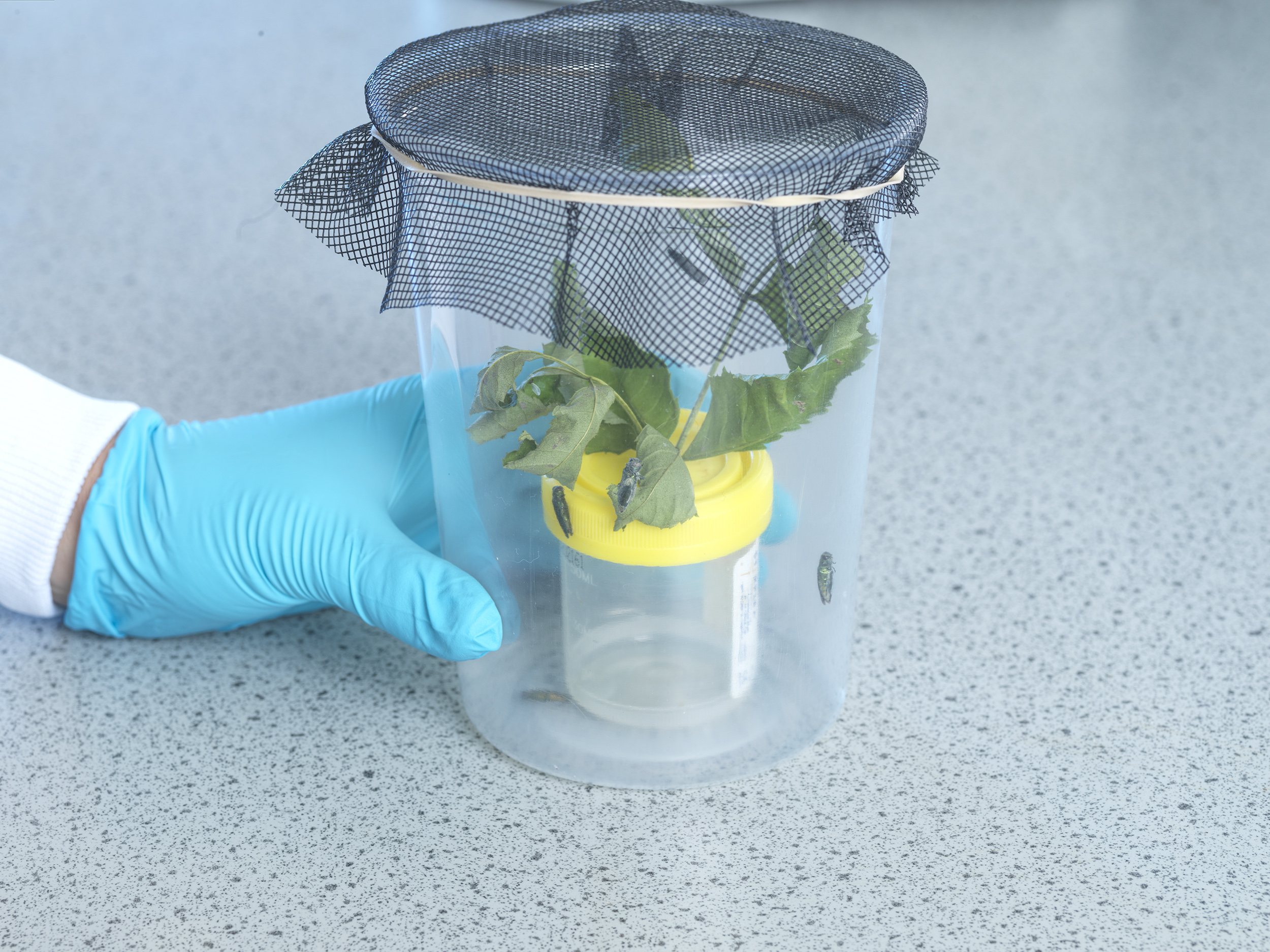
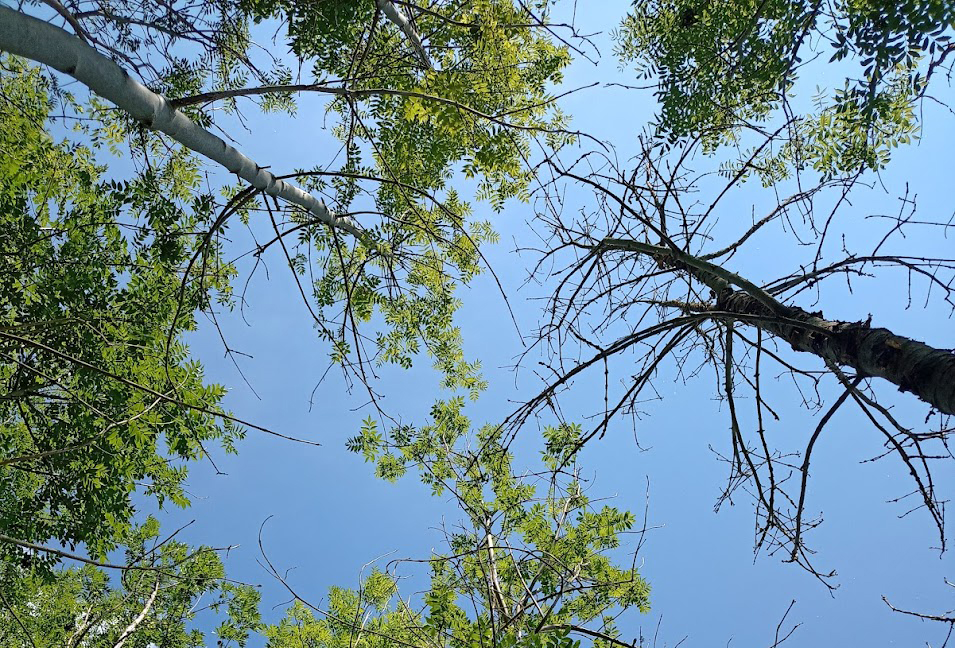
Over the last 20-30 years, ash trees in Britain have been affected by an invasive fungus (Hymenoscyphus fraxineus) that causes ash dieback, a disease which has killed large numbers of trees here and abroad. Another potential additional threat looming on the horizon is the emerald ash borer (Agrilus planipennis), a bark boring beetle native to Asia.
Previous research has led to the prediction that ash dieback will exacerbate the damage caused by the emerald ash borer (EAB) beetle. However, tree resistance to the ash dieback fungus could reduce the impact of the beetle.
Research aims and objectives
Aim
Produce many experimental European ash (Fraxinus excelsior) plants from breeding families identified as susceptible to ash dieback, resistant, or segregating, and also produce plants from EAB-resistant Asian ash species and EAB-susceptible American ash species.
Objectives:
Experimentally test risk to European ash posed by an invasive beetle related to the emerald ash borer
- Agrilus convexicollis is a non-regulated invasive bark boring beetle believed to be a secondary colonist of diseased ash trees, which seems to be already spreading widely in the UK. It is related to the EAB but is thought to be much less destructive to living trees. The project team will test if the larvae of this beetle can colonise healthy ash, working in the Forest Research containment facility.
Investigate the correlation of genetic resistance to ash dieback and to Agrilus beetle species
- Working in the Forest Research containment facility, using ash families with different levels of resistance to ash dieback, the team will test whether resistance to ash dieback makes trees more resistant to EAB.
Assess how coinfection influences the development of ash dieback and emerald ash borer damage
- The team will inoculate trees with both the ash dieback fungus and EAB larvae within the Forest Research containment facility. They will test the hypothesis that there is more damage to ash trees when they are attacked by both ash dieback and Agrilus together and determine how co-infection influences development of both the fungus and beetle larvae.
Assess the attractiveness of healthy and diseased ash to Agrilus beetles
- Female beetles who are ready to lay their eggs will be exposed to the odours produced by trees with and without ash dieback, to see if there is a preference between the two.
Expected outcomes
- Development of innovative methods to work with a pest and a pathogen together.
- Collection of information resulting in a report on the risk posed to UK ash by Agrilus convexicollis.
- Better understanding of the links between resistance to ash dieback and resistance to the EAB.
- Determining how attractive diseased and healthy ash trees are to Agrilus beetles.
- The data produced in this project will feed into the UK government’s strategies for breeding ash trees resistant to ash dieback, and for managing the emerald ash borer if it is found in the UK.
Further resources linked to this project
CFP Pilot Project (2021-2022)
See previous research on this topic from CFP pilot project: Consolidating and curating datasets for ash genomics.
Ash dieback damage
Title image: Andrew Brookes, Forest Research
Body image: Daniel Wood, Royal Botanic Gardens Kew
Glossary & Key Terms
Agrilus convexicollis beetle
A non-regulated invasive bark boring beetle believed to be a secondary colonist of diseased ash trees. It is related to the emerald ash borer (Agrilus planipennis) but is thought to be much less destructive to living trees. It was first discovered in the UK in 2023 in Surrey.
Ash dieback (Hymenoscyphus fraxineus)
A highly destructive disease of ash trees (Fraxinus species), caused by the fungus Hymenoscyphus fraxineus, which leads to leaf loss, crown dieback, and often the death of affected trees. It is present in the UK and particularly affects the native common ash. For more information, see Ash dieback (Hymenoscyphus fraxineus) - Forest Research.
Ash (Fraxinus)
Broadleaf deciduous trees of the genus Fraxinus, including native species such as common ash/European ash (Fraxinus excelsior) , which are valued in Britain for their strong, flexible timber and high ecological importance, but are now severely threatened by ash dieback disease. For more information, see Ash (AH) - Forest Research.
Emerald ash borer (Agrilus planipennis)
A highly destructive non‑native beetle that attacks ash trees by tunnelling under the bark, damaging the tissues that carry water and nutrients and usually causing the tree to die. It is not known to be present in the UK. For more information, see Emerald ash borer beetle (Agrilus planipennis) - Forest Research.
Genetic
Refers to genes - the segments of DNA that contain instructions for how living things grow and function.
Inoculate
Invasive non-native species (INNS)
A non-native organism that establishes, spreads, and causes harm to its new environment, threatening biodiversity, ecosystems, and the economy. These species, which can be plants, animals, bacteria, or other life forms, often outcompete native species for resources and lack natural predators in their new habitat, leading to significant ecological and economic damage. For more information, see The Great Britain Invasive Non-Native Species Strategy 2023 to 2030.
Pathogen (& Pathogenicity)
An organism or agent that can cause disease. Pathogens include viruses, bacteria, fungi, and protists. They can infect a wide range of hosts, including plants and animals. Pathogenicity is the ability of a pathogen cause disease.
Pest
Any organism including insects, fungi, bacteria, viruses, nematodes, or other pathogens that can cause harm to trees or tree products (in the context of forest protection).
Share this project on social media
Related Projects
Our partners



Social media
Explore
Newsletter
Contact us
© 2026 Centre for Forest Protection. All rights reserved.