
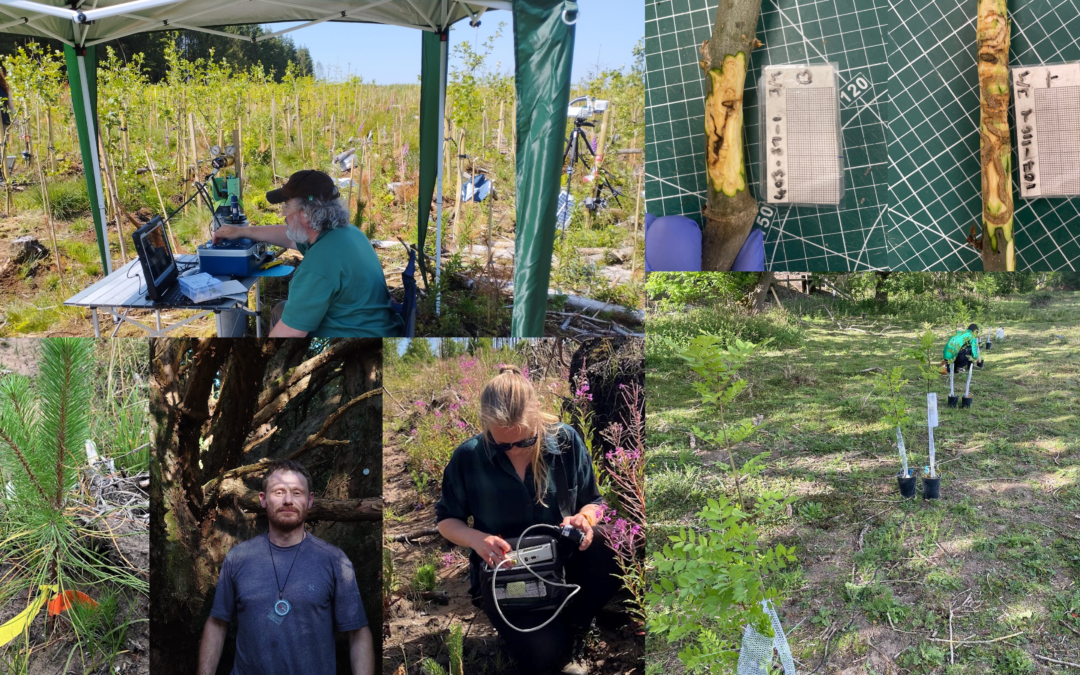
It’s been a busy and exciting summer for the Centre for Forest Protection (CFP). From conducting vital fieldwork, which you can read about in today’s blog, to sharing new research at conferences to making appearances on television (find out more next week!), our researchers have been showcasing their expertise and advancing our understanding of forest health both in the field and beyond.
Dodging the double whammy project
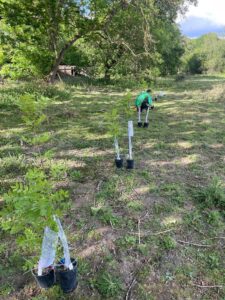
Field experiment set up with potted F. excelsior trees at known A. convexicollis sites. © Crown Copyright. Centre for Forest Protection; Forest Research – Dr Anastasia Uglow.
During the past year, work on our Dodging the double whammy – ash dieback and emerald ash borer project has focused on developing and validating methods for rearing Agrilus convexicollis (a non-regulated invasive bark boring beetle believed to be a secondary colonist of diseased ash trees) under laboratory conditions, establishing experimental protocols, and investigating aspects of the species’ life history.
A laboratory colony has been successfully maintained, with adults reproducing and providing eggs for use in experimental studies. Field and controlled-environment trials have also been established to assess colonisation of European ash (Fraxinus excelsior) material under different host conditions, including girdled and ungirdled trees as well as potted saplings. These trials are supporting the development of methods for evaluating host use and behaviour, while complementary laboratory experiments are being used to refine understanding of the species’ development and biology.
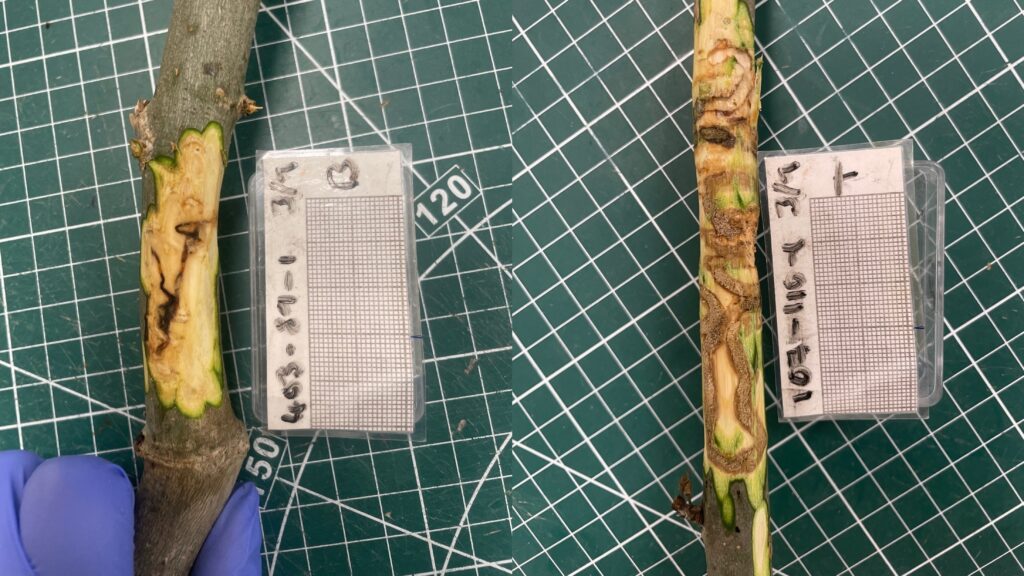
(Left) Tree showing potential resistance to EAB; (right) Tree showing potentially less resistance. © Crown Copyright. Centre for Forest Protection; Forest Research – Dr Anastasia Uglow.
Elsewhere in the project, during the summer season, large potted F. excelsior trees were assessed for ash dieback (ADB) response using attached leaf tests. The methodology was established with training and guidance from Dr Elizabeth Orton at the John Innes Centre. The same trees were subsequently inoculated with emerald ash borer (EAB) eggs and larvae were allowed to develop under controlled conditions. Throughout the study, a range of larval development metrics, ADB assessment data, and host response observations were collected.
This work has provided valuable experience in preparation for the main experiments planned for next year. In particular, it has helped refine the timing and application of attached leaf tests, improve identification and assessment of ADB lesions, and inform the selection of larval and host-response measurements for future investigations into the interaction between ADB and EAB.
Enhancing forest resilience through stand structural complexity project
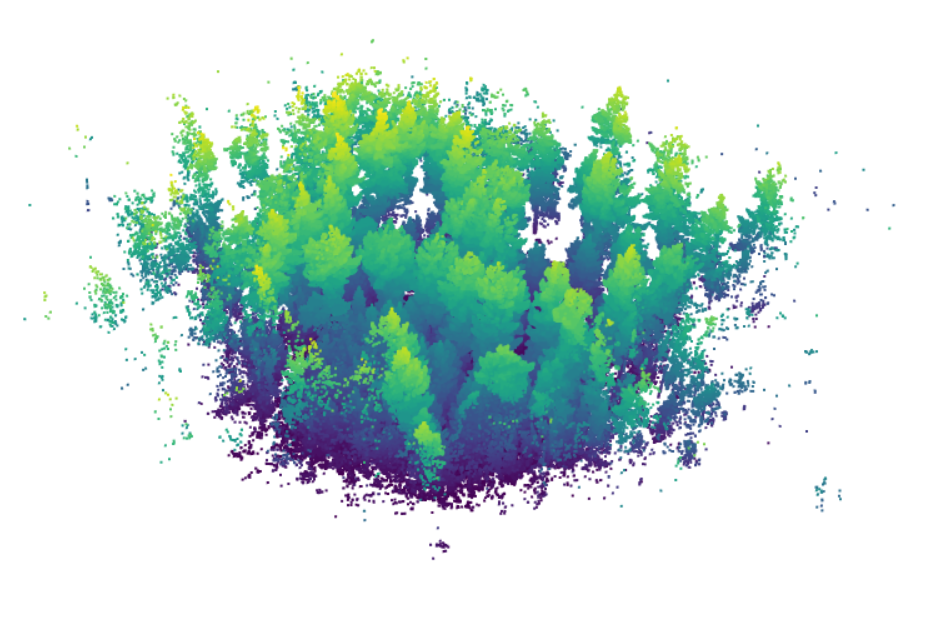
Ground-based mobile LIDAR scan, colourised to show the forest height © © Crown Copyright. Centre for Forest Protection; Forest Research – Dr Tom Ovenden.
Researchers from across our Enhancing forest resilience through stand structural complexity project have been busy this summer, with teams conducting fieldwork campaigns, networking at a regional specialist study group meeting, and developing analysis methods.
Following a successful pilot study in 2025, researchers focused their 2026 efforts on collecting data from Douglas fir dominated sites that cover a broad spectrum of forest structures. Since June, the team have collected over 1,600 cores from 830 trees across 25 sites located in Thetford Forest and the Forest of Dean, which are subsequently processed to generate tree-ring data that indicate responses to environmental conditions and stressors (e.g. drought).
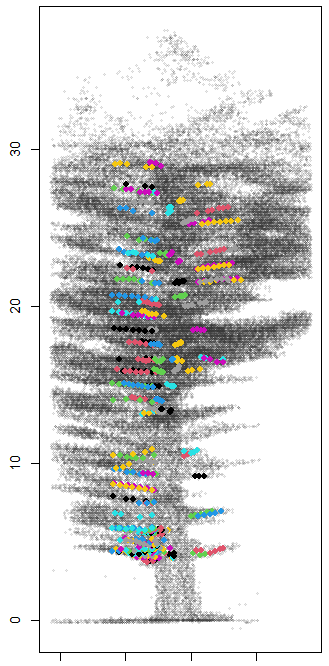
Automated branch detection (coloured points) from a point cloud generated from ground-based mobile LiDAR © Crown Copyright. Centre for Forest Protection; Forest Research – Dr Rubén Manso.
Each site was also scanned using ground-based mobile LiDAR to generate corresponding high-resolution 3D imagery of the forest, from which relevant tree- and plot-level structural metrics can be calculated. These data will be combined to investigate the relationship between forest structural diversity and drought response of trees.
For the purpose of predicting what is inside the trees (wood properties) from what we see outside them (ground-based mobile LiDAR), researchers have been developing methods to extract variables known to affect wood properties from the point clouds collected in 2025. This method can very rapidly detect and identify branches up to 30m in height, from which relevant metrics such as branch density, insertion angle and a proxy for insertion diameter can be built. These metrics will be paired with measured wood properties to investigate their predictive power.
Scots pine resilience project
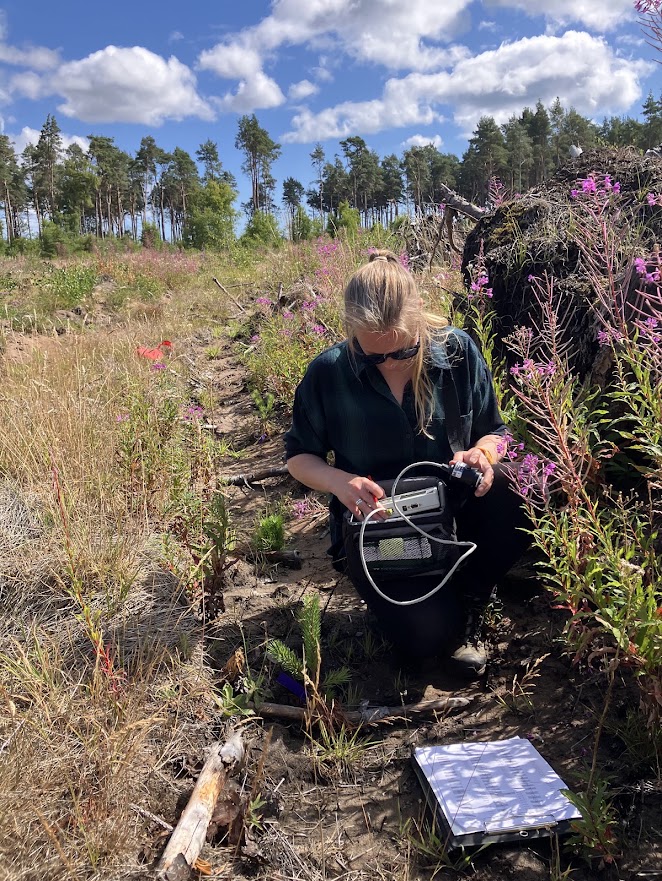
Dr Annika Perry taking chlorophyll fluorescence measurements of Scots pine needles, a good indicator of plant health © Crown Copyright. Centre for Forest Protection; Forest Research – Dr Thomas Sim.
This summer, our Scots pine resilience team have been putting both trees and equipment to the test at their field site in Tentsmuir. Across three visits, they assessed tree health using visual surveys and measurements of chlorophyll fluorescence, a useful indicator of plant performance and stress. On one occasion, temperatures approached 30°C, creating challenging conditions for both researchers and trees. In fact, the heat proved too much for their chlorophyll fluorescence instrument, which temporarily refused to cooperate.
Fortunately, repeated site visits are built into the project design, allowing the team to capture reliable measurements across the season despite the occasional setback. They also took advantage of their time on site to carry out mechanical weeding, reducing competition from brambles and other vigorous vegetation around the young trees.
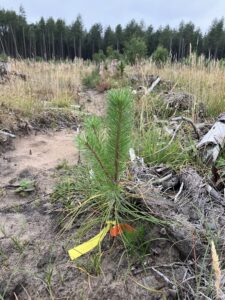
Scots pine seedling at the Tentsmuir trial site, with mature Corsican pine in the background © Crown Copyright. Centre for Forest Protection; Forest Research – Dr Thomas Sim.
The trial brings together Scots pine seedlings from five native Caledonian pinewood provenances alongside European seed sources from Spain and Norway. These trees were planted at Tentsmuir Forest in Fife during spring 2026, having already experienced contrasting drought, waterlogging or control treatments during a pot-based glasshouse experiment the previous summer. The site itself offers a unique opportunity to study disease interactions, being located near Scots pine and Corsican pine affected by Dothistroma needle blight (DNB).
Over the coming years, the team hope natural inoculation will allow them to investigate how trees from different provenances respond to the successive challenges of abiotic stresses (drought or waterlogging), and biotic stresses (DNB). Ultimately, the project aims to improve our understanding how Scots pine populations will respond to a changing climate.
Researching complex yew decline project
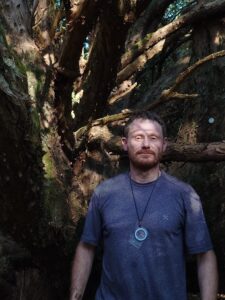
Geoff during project fieldwork this summer © Crown Copyright. Centre for Forest Protection.
Over the summer, PhD student Geoff Monck and members of the wider Researching complex yew decline project have been collecting needle, bark, and fine root samples for metabolomics and microbiome analysis. The work to process and run the samples is currently underway, and the team were joined by a new intern in October who will be supporting the lab work, as well as the further survey and sampling work planned for this autumn/winter.
In July, Geoff also presented his work on adjacent yew decline related projects at the Herefordshire Parklands Conference!
EXPLORATION project
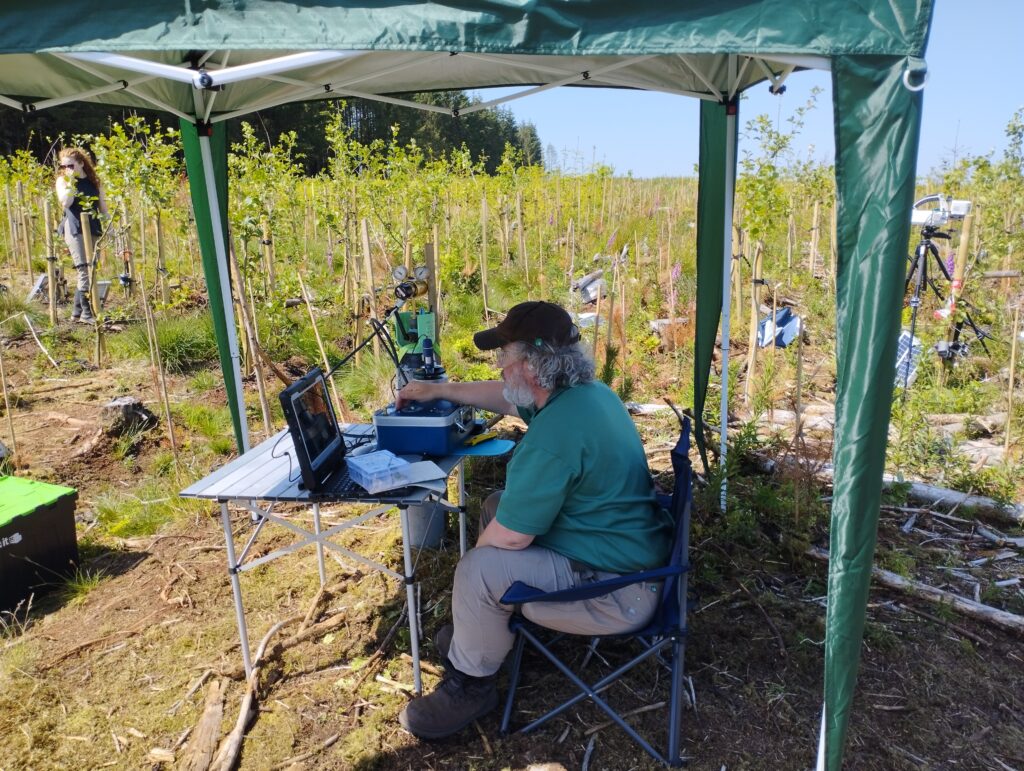
Dr George Xenakis, EXPLORATION project lead, during fieldwork in Wark Forest, Northumberland © Crown Copyright. Centre for Forest Protection; Forest Research.
This summer was a busy and rewarding period for our EXPLORATION project. Over this year’s field season, the team carried out an intensive monitoring programme at Wark Forest, Northumberland, where drought is expected to become an increasingly important challenge. You can find out more detail about this fieldwork and early observations from the team’s data analysis in a standalone blog written by project lead Dr George Xenakis coming soon!
–
We are delighted to have been able to showcase some of the fascinating field research undertaken across our projects this summer. A huge thank you to all the research teams who contributed to this feature, and to everyone across the CFP network for your continued dedication and hard work in supporting the health and resilience of our trees and forests.
Join us next week as we look back on the conferences attended by our project teams throughout the summer and celebrate two of our scientists who were featured in BBC interviews discussing their CFP research.
Stay connected!
Keep an eye on our website, follow us on social media (LinkedIn & Bluesky) and subscribe to our newsletter to be kept up to date on the latest CFP research, news and events!