
Horizon scanning for tree health
Project leads Katy Dainton, Dr Daegan Inward | Forest Research
Lead organisation Forest Research
Collaborator The Canadian Forest Service
Project status Pilot year project complete
Project funding £68,000
Research outcomes Resistance I Response I Adaptation
Context
British forestry is highly reliant upon non-native tree species, with two-thirds of conifer plantations consisting of species which originate from coastal western North America, most notably Sitka spruce (Picea sitchensis) and Douglas fir (Pseudotsuga menziesii). These are critical species for storing carbon, new woodland creation, and commercial softwood production. Identifying potential future threats to these trees is critical to ensure future forest health and to inform new tree planting schemes.
Most plantations have remained largely free of pests and diseases until recently, but the newly introduced larger eight-toothed European spruce bark beetle (Ips typographus) and a disease caused by the pathogen Phytopthora pluvialis are currently a problem. The threat of pests and diseases is made worse by both climate change and by creating plantations of trees of the same age and a single species.
Today there is a worldwide pool of potentially damaging organisms that could enter the UK, so robust ‘horizon scanning‘ (HS) methods are needed to predict future risks. A completed Centre for Forest Protection pilot project highlighted that existing methods are limited in their ability to reliably identify future threats to a particular tree species.
Limitations include failure to use local-scale future climate projection data, which provides data on changes in growing conditions, and risks such as increased drought and climatic suitability for the pest/pathogen. There is also an over reliance on professional judgement and traditional pest risk assessment by experts.
Research aims and objectives
Aim:
- Develop a framework for horizon scanning that is innovative, data-driven, and future-focused, which can be applied to other species, including native British species growing in other parts of the world.
Objectives:
- Evaluate existing published horizon scanning approaches for their advantages and limitations.
- Evaluate other risk analysis or biosecurity modelling studies, that can be incorporated into a more targeted analysis for key tree species.
- Identify the data and tools that are available to support HS methods for identifying threats, including pests and diseases, to British grown trees.
- Investigate and determine the value of a collaborative international approach.
Main findings
The rapid review of existing horizon scanning and modelling approaches has identified a range of potential methods and assessed them for gaps and opportunities. We have proposed a framework for a robust, data-driven horizon scanning approach that takes greater account of changing climate and rich, detailed data sources, and recommended a practical workflow for an assessment for Sitka spruce and Douglas-fir.
The project identified opportunities for transdisciplinary research and international collaborative working to tackle forest health issues that cross borders.
Further resources linked to this project
Pilot Project Summary Report: Evaluating horizon scanning methods to assess threats to British grown trees (Published: 25 February 2025)
British forestry is highly reliant upon non-native tree species such as Sitka spruce and Douglas-fir which originate from western North America. However, non-native trees may be at risk from native pests and diseases, the threats of which can be intensified by climate change. There is, therefore, an urgent need to develop approaches for identifying potential new threats, to inform new tree planting schemes and ensure future forest health.
This project aimed to develop an innovative, data-driven horizon scanning framework for identifying threats to key tree species growing in Britain. The approach could also be extended to other species, including native British species growing in other parts of the world.
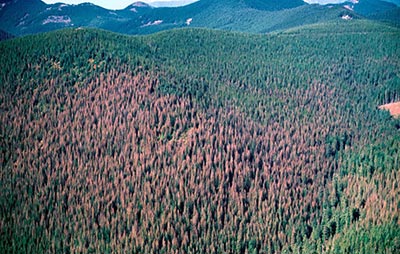
Aerial view of defoliation by the western spruce budworm in Mount Hood National Forest.
Glossary & Key Terms
Biosecurity modelling
The use of data-driven analytical frameworks and predictive tools to assess and anticipate risks posed by pests, diseases, and environmental stressors to tree species.
Conifer (Pinophyta)
Cone-bearing and usually evergreen trees. They are a distinct group of trees that are economically significant due to their ability to grow quickly even on poor soils and in harsh climates. These trees yield timber that is highly suitable for industrial use, which has led to their widespread planting and management across many countries. Examples of conifer trees found in the UK include Scots pine, Douglas fir, and Norway spruce.
Douglas fir (Pseudotsuga menziesii)
Tall evergreen conifers of the genus Pseudotsuga, native to western North America and widely planted in Britain for commercial forestry, where they are valued for fast growth, high‑quality timber, and importance as a principal forestry species. For more information, see Douglas fir (DF) - Forest Research.
Eight-toothed European spruce bark beetle (Ips typographus)
A small but highly destructive insect that attacks spruce trees by burrowing under the bark, where it damages the tissues that transport water and nutrients, often weakening or killing the tree, especially when beetle numbers are high. It is present in the UK. For more information, see Larger eight-toothed European spruce bark beetle (Ips typographus) - Forest Research.
Horizon scanning
The systematic process of identifying and asessing potential threats from non-native tree pests and diseases before they become significant problems.
Pathogen (& Pathogenicity)
An organism or agent that can cause disease. Pathogens include viruses, bacteria, fungi, and protists. They can infect a wide range of hosts, including plants and animals. Pathogenicity is the ability of a pathogen cause disease.
Pest
Any organism including insects, fungi, bacteria, viruses, nematodes, or other pathogens that can cause harm to trees or tree products (in the context of forest protection).
Pest risk analysis
A process to identify appropriate phytosanitary (plant health) measures required to protect plant resources against new or emerging pests and regulated pests of plants or plant products. It evaluates biological or other scientific and economic evidence to determine whether an organism is a pest, whether it should be regulated, and the strength of any phytosanitary measures to be taken against it.
Phytophthora pluvialis
A fungus‑like plant pathogen that infects trees, particularly conifers such as western hemlock and Douglas fir, causing needle loss, shoot dieback, and stem damage that can weaken or kill affected trees. It is present in parts of the UK. For more information, see Phytophthora pluvialis - Forest Research.
Risk analysis
A process that evaluates the likelihood and possible impact of future threats on tree health and ecosystems.
Sitka spruce (Picea sitchensis)
Fast‑growing evergreen conifer trees of the species Picea sitchensis, native to the west coast of North America and widely planted in Britain, recognised for their ability to grow productively in cool, wet conditions, their importance as a major commercial timber species, and their dominance in UK forestry plantations. For more information, see Sitka spruce (SS) - Forest Research.
Share this project on social media
Related Projects
Our partners




Social media
Explore
Newsletter
Contact us
© 2026 Centre for Forest Protection. All rights reserved.