In September, we were pleased to highlight the exciting work of two CFP-funded PhD researchers in a series of free webinars.
The first webinar was led by Dr Alexandra Ash, Behavioural Ecologist at Forest Research, who presented her PhD research into the drivers of bark-stripping behaviour in invasive grey squirrels.
Alex explained that the reasons behind why grey squirrels bark strip are still largely unknown but given they have been identified as the greatest threat to broadleaf woodland health, costing Britain up to £37 million per year, it is even more essential that we attempt to manage this destructive behaviour.
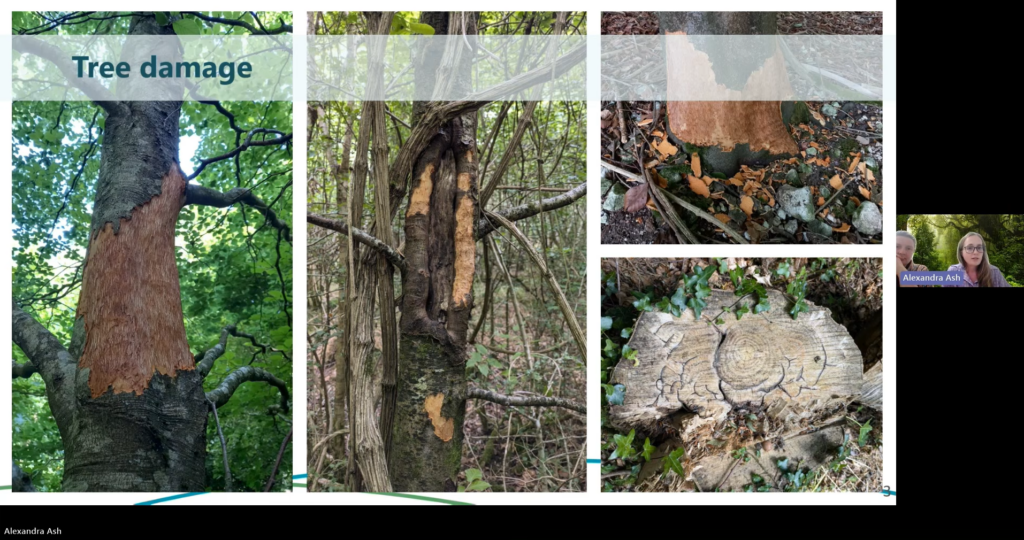
A screenshot from Alex & Cally’s talk with images showing the damage that grey squirrels can cause to trees © Crown Copyright. Centre for Forest Protection.
Alex then provided an overview of her research which looked into what might cause a different tree species to be more or less susceptible to bark stripping. Dr Cally Ham, Senior Mammal Ecologist at Forest Research, also gave an overview of ongoing CFP grey squirrel research, including development of novel tree protection methods, and a ‘tool-kit’ for studying grey squirrel behaviour.
Watch the webinar to learn more:
Understanding grey squirrel damage in UK woodlands webinar – YouTube | Centre for Forest Protection (you can also find additional resources in the video description).
The second webinar was led by Fritha West, Research Fellow at Defra, who presented her PhD research on the ecological and cultural restoration of elm in Britain.
Whilst Dutch elm disease has been present in the British ecosystem since at least the early 1900s, a particularly deadly strain arrived in the 1960s which has since decimated elm populations across the UK, with millions of trees dying per year. However, after decades of research, in genetics and conservation it now looks like elm restoration may be possible.
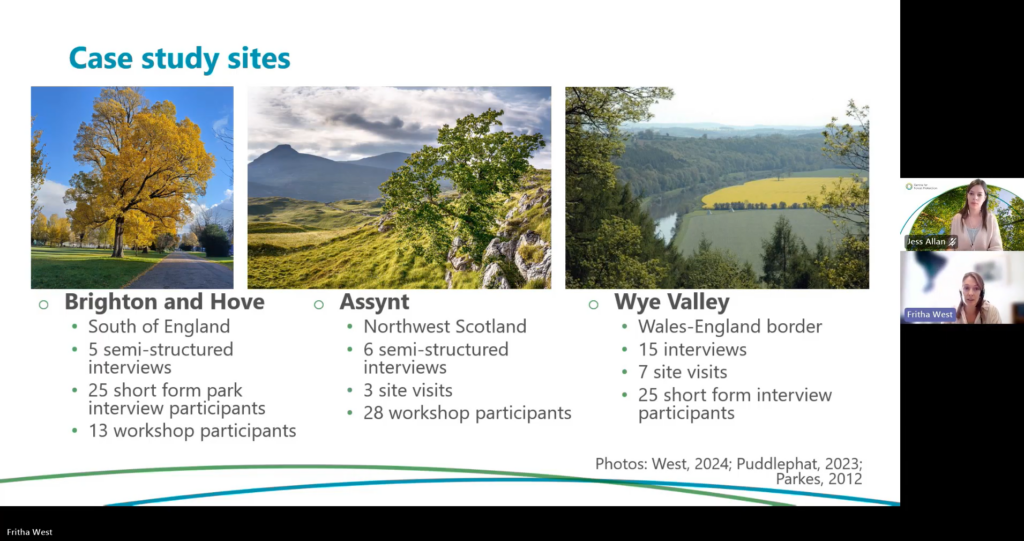
A screenshot from Fritha’s talk outlining the case study sites used in her research © Crown Copyright. Centre for Forest Protection.
To understand what is feasible in terms of restoration, Fritha’s research aimed to answer the following questions:
- What does it mean for a tree species to be considered ‘lost’?
- What does it mean to ‘restore’ lost tree species?
- How can we engage people in the combined ecological and cultural restoration of elm?
Watch the webinar to hear what she found:
Perspectives on the ecological and cultural restoration of elm in Britain webinar – YouTube | Centre for Forest Protection (you can also find additional resources in the video description).
We were delighted with the interest shown in these research topics. With over 430 attendees across the two webinars, this level of engagement highlights the importance of this research and the appetite for greater understanding in these areas.
If you attended either of these webinars live, or have watched the recordings, we would be really grateful if you could please take 5 minutes to complete our feedback survey: Centre for Forest Protection PhD Researcher Webinar Series – Feedback.
Last year, former CFP PhD researcher Dr Jiaqi Wei also gave a talk on her research which focused on assessing the potential impact of a bacterial pathogen, Xylella fastidiosa, on British trees. You can find a recording of her talk here:
A huge thank you to all of our presenters for providing interesting and insightful updates into their work to support the future of our trees and woodlands.
Stay connected!
Keep an eye on our website, follow us on social media (LinkedIn & Bluesky) and subscribe to our newsletter to be kept up to date on the latest CFP research, news and events!