
Speed breeding technologies for UK broadleaved trees
Project leads Prof Richard Buggs | Royal Botanic Gardens, Kew; Dr Andrew Plackett; Dr Graeme Kettles | University of Birmingham – School of Biosciences; Dr Netsai Mhlanga | Niab East Malling
Context
Due to new pests, pathogens, and climate change, we need to breed stronger broadleaved trees more quickly. New DNA sequencing technologies have enabled a better understanding of tree genetics, making it possible to speed up breeding using genetic markers.
However, trees can take many years to flower for the first time (their ‘juvenile’ stage), meaning that breeding is still a slow process. One way to get around this is to make trees flower earlier, using a technique called ‘speed breeding’ which has already been successful in annual crops such as cereals, and does not change the trees genetically.
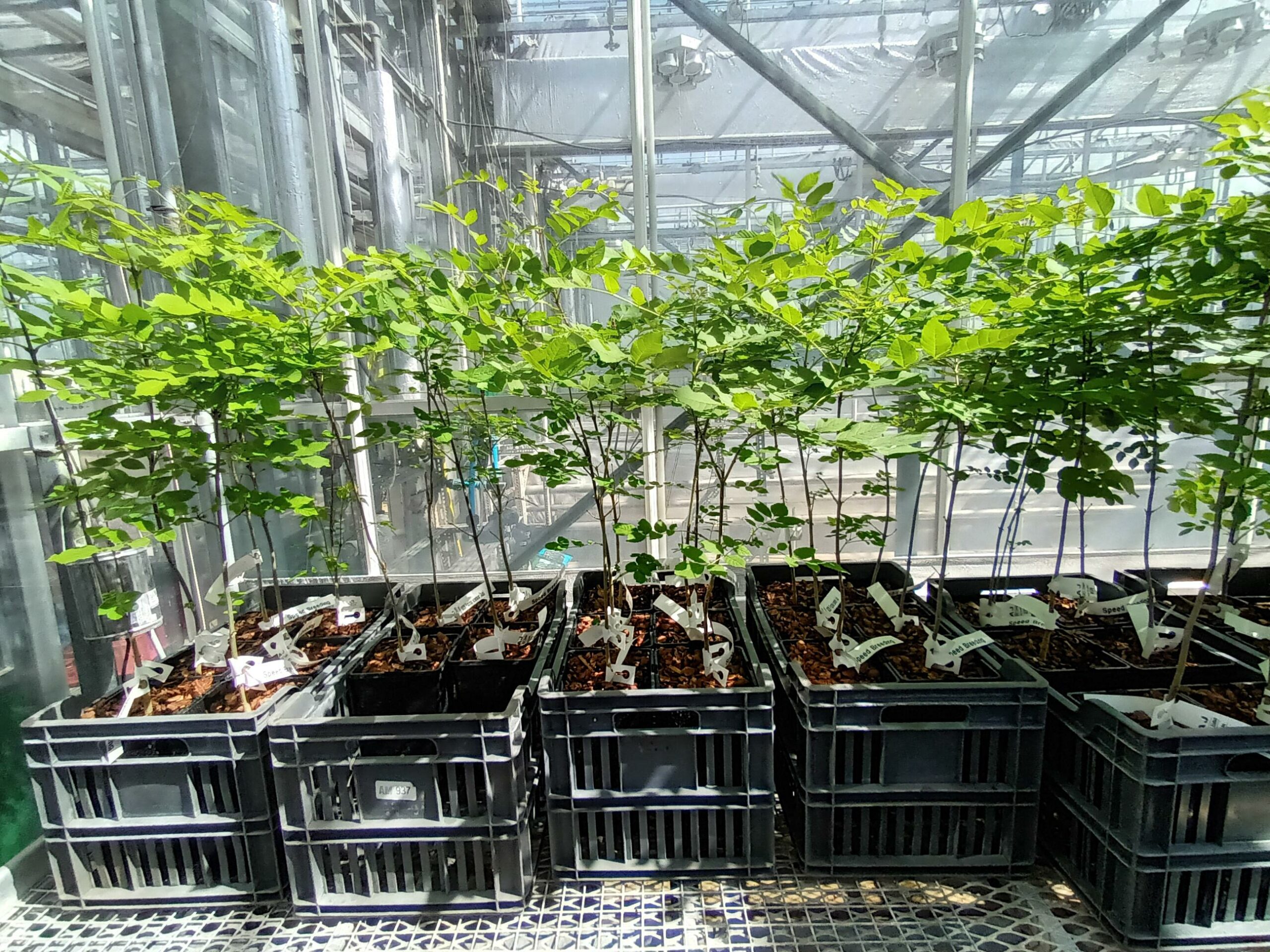
Scientists at Niab have been able to make apple trees flower years earlier by growing them under conditions with longer daylight hours, high carbon dioxide, and short artificial winters. This project will now test whether the same method can work for silver birch (Betula pendula), oak (Quercus robur), and ash (Fraxinus excelsior), with a focus on the latter due to the threats faced both from ash dieback (Hymenoscyphus fraxineus) and emerald ash borer (Agrilus planipennis).
Research aims and objectives
Aim:
Trigger early flowering in ash via environmental manipulation: using long day lengths, high carbon dioxide, and artificially short winters.
Objectives:
- Experiment on ash saplings, a proportion of which will be descended from parents resistant to ash dieback, which may be a resource for future breeding programmes.
- Test silver birch under the same conditions – silver birch has previously been shown to flower early under speed breeding treatments, so will be the control in the experiment.
- Test a small number of oak saplings under the same conditions – oak usually takes much longer to start flowering (25-40 years), and so speed breeding treatments may not be successful.
- Compare how genes behave differently in trees grown with speed breeding methods compared to control conditions in all three species. By doing this over time, a better understanding of the genetic changes that help trees to flower faster will be gained.
- A diverse population of ash trees from across the country will be collected to see if there are genetic differences that make ash more or less responsive to speed breeding.
Expected outcomes
- Establish that speed breeding can be achieved in ash and oak trees.
- Create a reliable method to make UK broadleaved tree species flower earlier.
- Map the genetic changes that happen in birch, ash, and oak under speed breeding conditions, to see if they share the same response. This will help to enable future prediction of whether speed breeding will work in other tree species and improve the method in future.
- Identify whether certain ash trees are more responsive to speed breeding conditions than others and identify which genes may be responsible.
Further resources linked to this project
News: Speed Breeding Project Takes Root at Niab, East Malling (Published: 13 November 2025)
News article: Speed Breeding Project Takes Root at Niab, East Malling.
On 21 October, the team behind Centre for Forest Protection Phase 2 project ‘Speed Breeding Technologies for UK Broadleaved Trees’ held their first in-person meeting to inspect their trees in person after the first season under speed breeding conditions.
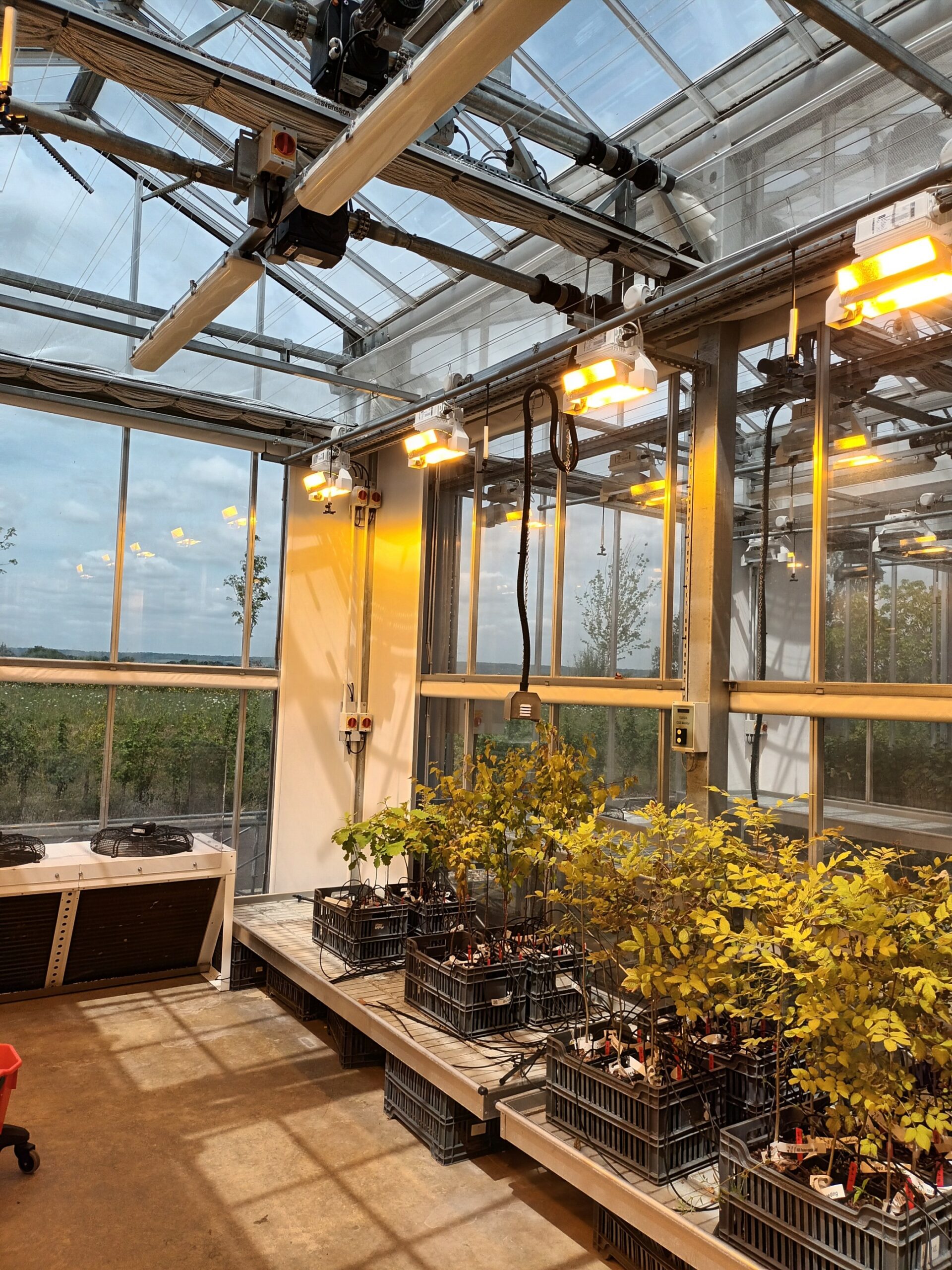
Title image: Abi Johnson, Niab East Malling
Body image: Abi Johnson, Niab East Malling
Glossary & Key Terms
Ash dieback (Hymenoscyphus fraxineus)
A highly destructive disease of ash trees (Fraxinus species), caused by the fungus Hymenoscyphus fraxineus, which leads to leaf loss, crown dieback, and often the death of affected trees. It is present in the UK and particularly affects the native common ash. For more information, see Ash dieback (Hymenoscyphus fraxineus) - Forest Research.
Ash (Fraxinus)
Broadleaf deciduous trees of the genus Fraxinus, including native species such as common ash/European ash (Fraxinus excelsior) , which are valued in Britain for their strong, flexible timber and high ecological importance, but are now severely threatened by ash dieback disease. For more information, see Ash (AH) - Forest Research.
Broadleaf/Broadleaved
A category of trees that have wide, flat leaves rather than needle-like leaves. These trees are usually deciduous and lose their leaves in winter.
DNA
Deoxyribonucleic acid - the biological instruction manual found inside every living cell. It dictates how an organism grows, develops, and functions.
Emerald ash borer (Agrilus planipennis)
A highly destructive non‑native beetle that attacks ash trees by tunnelling under the bark, damaging the tissues that carry water and nutrients and usually causing the tree to die. It is not known to be present in the UK. For more information, see Emerald ash borer beetle (Agrilus planipennis) - Forest Research.
Genetic markers
Specific DNA sequences that vary between individuals and can be used to identify trees, assess genetic diversity, and track traits like growth or disease resistance.
Genetics
The study of how traits are passed from parents to offspring.
Oak (Quercus)
Broadleaf deciduous trees of the genus Quercus, commonly found in British woodlands and forests, recognised for their strong timber, characteristic lobed leaves, and acorns, and including native species such as pedunculate oak (Quercus robur). For more information, see Oak - Forest Research.
Pathogen (& Pathogenicity)
An organism or agent that can cause disease. Pathogens include viruses, bacteria, fungi, and protists. They can infect a wide range of hosts, including plants and animals. Pathogenicity is the ability of a pathogen cause disease.
Pest
Any organism including insects, fungi, bacteria, viruses, nematodes, or other pathogens that can cause harm to trees or tree products (in the context of forest protection).
Silver birch (Betula pendula)
Fast‑growing deciduous broadleaf trees of the genus Betula, specifically Betula pendula, native to Britain and recognised by their white peeling bark, light crowns, and important role as pioneer species that quickly colonise open ground and support woodland biodiversity. For more information, see Silver birch (SBI) - Forest Research.
Speed breeding
A technique used to make trees flower earlier by manipulating environmental conditions specifically, by providing longer daylight hours, elevated carbon dioxide levels, and short artificial winters. This method does not involve genetic modification.
Share this project on social media
Related Projects
Our partners




Social media
Explore
Newsletter
Contact us
© 2026 Centre for Forest Protection. All rights reserved.